
This article walks you through the seven dropship marketing strategies I have my students actually run, in the exact order that keeps them profitable. Free organic traffic first. Real orders to prove the product. Paid ads to scale what already works. You will see the first step for each channel, a realistic example of how it plays out for a dropship store, the benchmarks I use before I let a student spend a dollar on ads, and the trust and compliance moves that keep traffic converting instead of leaking. By the end you will know which one or two channels to commit to for the next 90 days.
Will Smith put it in a line I have my students write at the top of every launch plan.
“Fail early, fail often, fail forward.” — Will Smith
That is the dropship marketing game in one sentence. Post the video that gets no views. Write the product page that does not convert. Send the email nobody clicks. Learn from each small failure, then take the next step. I have mentored more than 3,270 students across 17 years of ecommerce, and the ones who build real revenue did not pick a magic channel. They picked one or two channels and showed up weekly until the numbers moved. My dropshipping content marketing guide, my first-sale fast guide, and my dropshipping business plan guide all pair with the system below.
Why marketing, not the product, decides which dropship stores win
I have mentored more than 3,270 students, and the pattern is the same every time. Two stores sell a nearly identical item. One makes sales and the other does not. The difference is almost never the product. It is who knows the store exists and why they trust it.
When a supplier’s catalog is open to every seller, the item is not your edge. Your edge is the audience you build, the message you write, and the trust you earn. That is good news, because those are skills you can learn. My successful store examples, my high-demand products breakdown, and my dropshipping saturation guide all show the stores that built an edge instead of chasing a product.
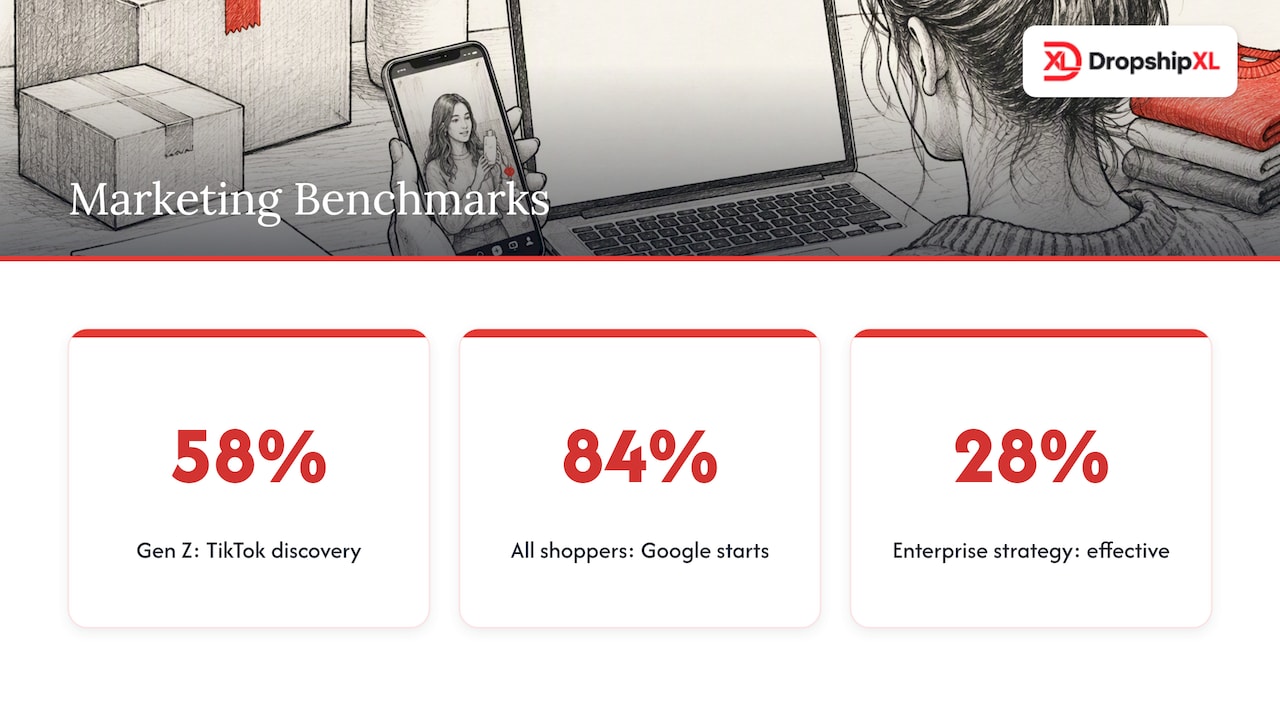
The buying journey has also shifted. In 2025, roughly 58 percent of Gen Z shoppers aged 18 to 29 discover and buy products through TikTok, while 84 percent of all shoppers still start their search on Google. So discovery happens on social, and confirmation happens on search and on your site. Shoppers are interested in what they find on social but skeptical of its quality. Stores that win pair social discovery with proof, like user-generated content and a transparent product page.
Content, SEO, and social work only as ongoing commitments. Industry research consistently finds that only a small share of enterprise marketers rate their content strategy as very effective, and the pattern behind weak results is treating content as a one-off project. For a small store, the lesson is simple. Pick fewer channels and show up every week.
The pacing rule I give every student (start free, validate, then pay to scale)
This is my coaching experience, not a universal law, but it has saved my students a lot of money.
Phase 1. Start free (weeks 1 to 8). Run organic social, set up the product page properly, and start collecting emails. Your goal is learning what message gets attention.
Phase 2. Validate with real orders (weeks 4 to 12). You want actual customers paying actual money. Here are the benchmarks I look for before I tell a student to consider paid ads.
- At least 10 to 20 real orders from organic traffic or email, from people who are not friends or family.
- One product page that has held a steady conversion rate over a few weeks, rather than a lucky spike.
- A clear picture of your margin after product cost, shipping, and transaction fees, so you know what you can afford to pay for a sale.
- At least one piece of content or one creative that clearly outperforms the rest.
- Shipping times, return policy, and contact details published and accurate.
Phase 3. Pay to scale. Put ad money behind the creative and product that already converted, starting small and raising budget in steps while you watch your numbers. If you cannot hit those benchmarks, ads will only make the problem more expensive. My niche validation steps, my dropshipping profit calculator guide, and my ecommerce metrics guide walk through the exact numbers to watch in each phase.
Strategy 1. Organic social on TikTok and Instagram
Organic short-form video is the cheapest way to test whether anyone cares about your product. It costs time, not cash.
Exact first steps I have my students follow
- Create a brand account on TikTok and Instagram with the same handle and a bio that states who the product is for.
- Write down 5 problems your product solves, and film one short video per problem (15 to 30 seconds, problem first, product second).
- Post once a day for 30 days. Use native sounds and on-screen text, and put one clear call to action in the caption.
- Keep a simple sheet of views, saves, link clicks, and orders per video.
My TikTok marketing guide, my guide to going viral, and my Manus video ad guide all cover the production rhythm that keeps this consistent.
A realistic example of how this plays out
Imagine a store selling a car trunk organizer. The owner films a 20-second clip of groceries sliding around a trunk, then staying put. Most posts get a few hundred views. One gets 40,000, and the store gets a handful of orders from it. That is a normal outcome. Most videos do little, and a few carry the results, which is why volume and tracking matter.
Strategy 2. Product page SEO that works for buyers and search alike
Social sends visitors who are curious. Search sends visitors who are ready. Your product page has to work for both.
Exact first steps for a page that earns search traffic
- Write a unique title and description for every product. Do not paste the supplier’s text, since many other stores use it.
- Use one primary phrase a buyer would type, and put it in the title, the first sentence, and the image alt text.
- Add Product and Offer structured data so your page is eligible for Google Shopping surfaces, and check your theme actually outputs the markup in the HTML.
- Add real photos or video, a short FAQ, and your shipping and return details on the page.
For the technical side, see my dropshipping SEO guide. For layout and trust elements, see my store design conversion guide, my product page optimization guide, and my trust badges guide.
A realistic example of a page rewrite that compounds
A pet store rewrites the page for a no-pull dog harness around the phrase “no pull harness for large dogs,” adds a size chart and a 30-second video, and answers three sizing questions on the page. It will not rank overnight, but pages like this build compounding traffic over months, and the sizing answers reduce returns right away.
Strategy 3. Pinterest for products people plan to buy
Pinterest behaves more like a visual search engine than a social feed. Pins keep circulating long after you post them, which suits products people plan to buy. Home, decor, fitness, gifts, weddings, kitchen.
Exact first steps for a new Pinterest account
- Open a business account and claim your website.
- Create 5 boards around the customer’s goal, such as “small apartment storage ideas,” not around your store name.
- Make 3 vertical pins per product (2:3 ratio) with a short text overlay and a keyword-rich title and description.
- Link every pin to the matching product or blog page, and pin 3 to 5 times a week.
My organic traffic guide and my traffic playbook both cover how to amplify Pinterest with the other free channels in this article.
A realistic example of Pinterest working for a small store
A store selling floating shelves builds a board called “renter-friendly wall decor” and pins lifestyle images of the shelves in small rooms. Early traffic is small. The payoff is that those pins keep sending visitors for months, so a month of pinning can still produce clicks long after you stop.
Strategy 4. Email marketing to the audience you actually own
Email is the channel you own. Platforms change algorithms. Your list does not. Personal, helpful communication is one of the clearest ways to turn casual shoppers into repeat buyers.
Exact first steps for a store starting from zero subscribers
- Add a signup form offering something real. A first-order discount, a buying guide, or early access to new products.
- Set up a three-email welcome sequence. A thank-you with the offer, a story about why you chose the product, and a reviews-and-FAQ email.
- Set up an abandoned cart email that goes out within a few hours.
- Send one useful email a week, with a how-to or tip first and the product second.
My repeat buyers breakdown covers why email is the highest-leverage retention channel, and my batch task guide shows how to keep the weekly send routine from eating your evenings.
A realistic example of email picking up the sale
A home-fitness store offers a free resistance band workout guide for an email address. The welcome series shares the guide, then a customer photo, then a small discount. A visitor who did not buy on the first visit comes back through the third email. Email rarely brings the first customer, but it often brings the second sale.
Strategy 5. Paid ads once you have earned the right to spend
Paid ads are an accelerator, not a starting point. They multiply what exists, whether that is a winning product or a leaky page.
Exact first steps for your first paid campaign
- Confirm you meet the benchmarks in the pacing section above.
- Take your best organic video and run it as an ad with a small, fixed daily budget.
- Test one variable at a time. Hook, offer, or audience.
- Set a stop rule before you start. Pause any ad that spends your break-even cost per sale with no purchase.
- Install the pixel or tracking tag and confirm purchases are recorded before you spend.
My Facebook ads for dropshipping guide, my Facebook vs TikTok ads breakdown, my Google Ads vs Facebook Ads comparison, and my conversion tracking guide all pair with this phase.
A realistic example of boosting a proven video
The trunk organizer store from earlier takes its 40,000-view video, runs it as an ad for a week at a small daily budget, and compares cost per sale to its margin. If the numbers work, it raises the budget by a modest step every few days. If they do not, it changes the hook, not the whole store.
One legal point sits right here. US rules require a reasonable basis for any shipping time you advertise, and if you state none, you have to ship within 30 days or notify the customer and offer cancellation or refund. Using a dropshipper does not change that responsibility. My returns address guide, my chargebacks guide, and my fraud prevention guide cover the shipping and refund side in depth.
Strategy 6. Influencers and UGC that close the trust gap
User-generated content and creator partnerships solve the trust gap. A stranger’s honest video does what your product description cannot.
Exact first steps for your first UGC batch
- Order your own product so you know what it looks like and how it performs.
- Find 10 micro-creators in your niche with engaged, small audiences. Message them with a clear offer. A free product, plus a flat fee or commission.
- Ask for a specific deliverable. One 30-second video, unboxing plus one real use case.
- Get written permission to reuse the video on your product page and in ads.
My influencer marketing guide and my affiliate marketing guide both cover the mechanics side of creator partnerships.
How to follow the FTC rules on reviews and endorsements
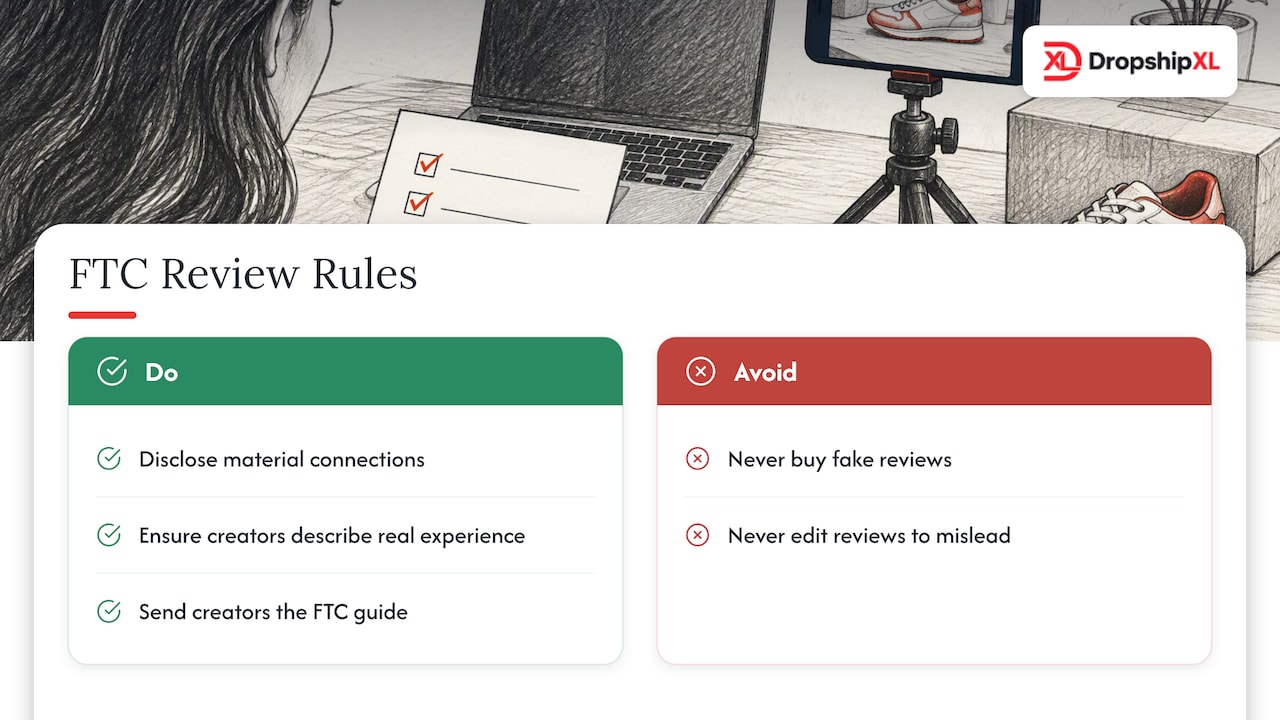
Creators have to disclose material connections, and you are responsible for making sure they describe their real experience. Never buy fake reviews or edit them to look better than they are. Civil penalties apply to knowing violations of the US rule on fake and undisclosed endorsements, so a one-page disclosure brief for every creator you work with pays off.
A realistic example of UGC built from eight samples
A kitchen gadget store sends free samples to 8 micro-creators. 5 post, 2 videos are good, and one becomes the top element of the product page. The store pays for the rights to use it in ads. The result is not a viral hit, but you have authentic proof you did not have to make up.
Strategy 7. Blog SEO that brings buyers in earlier
Blog content brings in buyers earlier in their research. It is the slowest strategy here and one of the most durable, and it fits the consistency point from earlier.
Exact first steps for a weekly blog cadence
- List 10 questions your buyers ask before purchasing. Sizing, comparisons, how-tos, and “best for” queries.
- Write one genuinely useful post per week, 800 to 1,200 words, with your own photos and a clear next step.
- Link each post to the relevant product or collection page.
- Update your best posts every few months.
My dropshipping content marketing guide and my organic traffic guide both show how to turn content into sales over the first 90 days.
A realistic example of a blog post that quietly compounds
A yoga accessories store writes “how to choose a yoga mat thickness,” with a simple chart and a recommendation for each type of practice. The post attracts a few visitors a day after a few months, and every one of them is already comparing mats.
How the 7 strategies compare at a glance
These ratings are my judgment from coaching students, not measured industry data. Use them to choose, not to predict results.
| Strategy | Cost | Speed to first results | Difficulty |
|---|---|---|---|
| 1. Organic social (TikTok, Instagram) | Low (time, phone) | Fast: days to weeks | Medium |
| 2. Product page SEO | Low | Slow to medium: weeks to months | Medium |
| 3. Pinterest | Low | Medium: weeks to months | Low to medium |
| 4. Email | Low to medium (software) | Medium, needs traffic first | Low |
| 5. Paid ads | High (ad budget) | Fastest once validated | High |
| 6. Influencers and UGC | Medium (products, fees) | Medium | Medium |
| 7. Blog SEO | Low (time) | Slowest: months | Medium |
My dropship automation guide covers how to keep whichever two channels you pick on a sustainable weekly rhythm.
What actually moves the needle in my coaching
I teach a seven-step process, the same one I use to build and scale my own ecommerce brand. Marketing sits in the middle of it for a reason. Before you spend on traffic, you should know your niche, have a supplier you trust, and have a store that looks credible. Skip those and the marketing leaks.
The students I see make real progress do three things. They choose one channel and stay on it. They treat the first 10 orders as research, not revenue. And they keep their promises on shipping, returns, and reviews, because trust is cheaper than ads. A shiny strategy applied inconsistently loses to a plain strategy applied every day. My one-product store guide, my launch checklist, my scaling strategies guide, and my scaling walkthrough all expand on this long game.
Mentor Tip. I have my students commit to a 90-day window on their chosen two channels before they allow themselves to change the plan. Switching strategies every 2 weeks is the single most expensive habit I see in new dropshippers, and 90 days is long enough to tell signal from noise.
How to pick one or two channels and start this week
You do not need all seven. Here is how I would choose.
- Comfortable on camera and want fast feedback. Organic social, with email as your second channel.
- Prefer writing and long-term compounding. Product page SEO plus blog SEO.
- Selling home, decor, fitness, or gifts. Pinterest plus email.
- Already have validated orders and margin. Add paid ads and UGC.
Pick, commit for 90 days, track results weekly, and keep your shipping promises. That is the whole plan.
How DropshipXL helps you build the store your marketing sends people to
If you want a structured path, my DropshipXL Academy Membership is 997 dollars per year and walks you through the full seven-step process. If you would rather have your store built for you, my MVP PRO Dropship Design Package is 2,897 dollars one-off, with lighter options available.
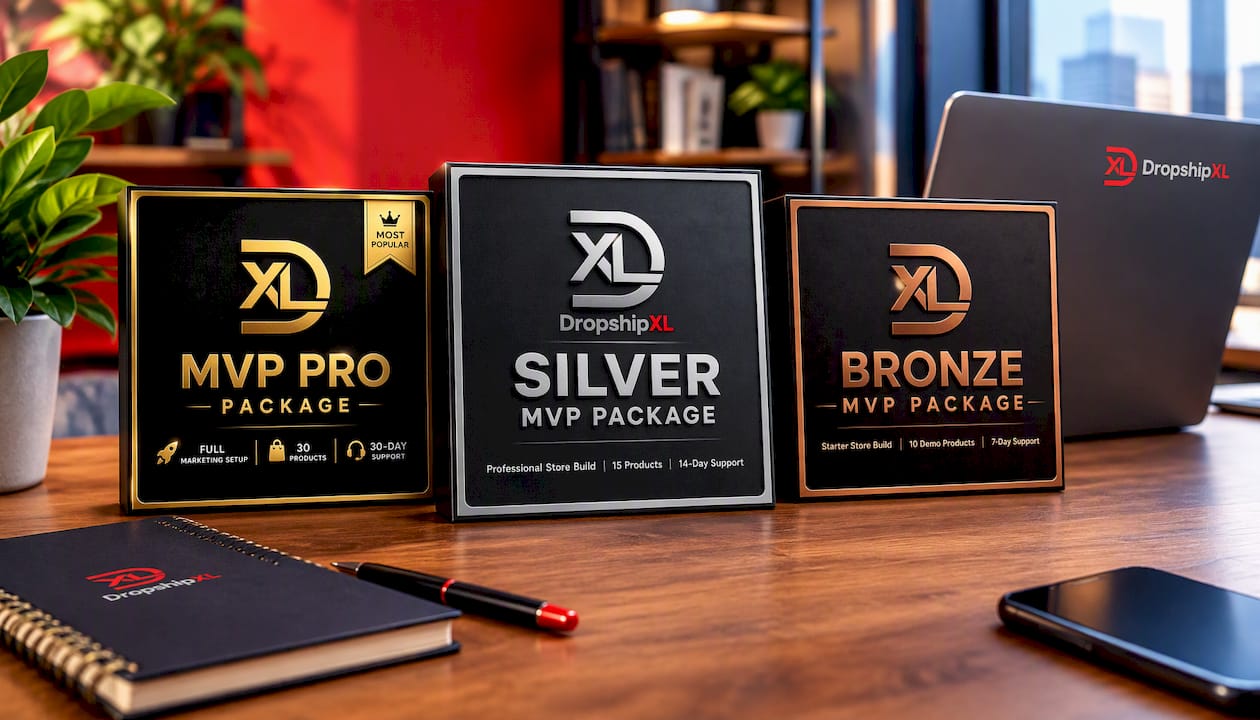
- MVP PRO Dropship Design Package. A done-for-you store built around a validated product your marketing can land traffic on.
- DFY Focus 1 and Mentoring package. A lighter 697-dollar starting point for a single high-converting page with direct guidance.
- Free 30-minute dropship mentoring call. Walk through your two-channel plan together before you commit any budget.
- Ongoing 1-on-1 dropship mentoring. Personal guidance for sellers who want hands-on help.
FAQ
What is the most profitable dropshipping business
There is no single most profitable niche. Profit comes from margin, repeat purchases, and how cheaply you can get customers. Products solving a clear problem for a specific audience, with room for a healthy margin after costs, do better than trend items everyone sells.
Why do so many dropshippers fail at marketing
They jump between products and channels, spend on ads before validating, and ignore trust factors such as shipping times and clear policies. Consistent marketing on one or two channels beats scattered effort every time.
Can I really dropship with zero dollars
You can start marketing with very little, because organic social, Pinterest, and blog content cost mostly time. You will still need money for a domain, a store platform, and ideally a sample of your product. Treat any “zero cost” claim with caution.
Can I make 10,000 a month dropshipping
It is possible, but results vary widely. It takes a validated product, a healthy margin, steady traffic, and time. Work backward. Divide your target by profit per order to see how many orders per month you need, then see which channels can realistically deliver that.
When should I actually start running paid ads
When you have real orders from organic traffic, a stable product page, known margins, and a creative that already performs. I look for roughly 10 to 20 organic orders first. If you do not have those, fix the page and message before paying for traffic.
Do FTC rules apply to dropshippers
Yes. US rules make you responsible for shipping time statements and refunds even if a supplier ships the order, and the rule on reviews and testimonials covers fake or undisclosed endorsements. For specific legal questions about your business, talk to an attorney.

Here are 4 other ways I can help you when you're ready: