
This article walks you through 30 low-cost organic traffic tactics for a dropshipping store, grouped into seven channels you can work through one at a time without a media budget. Under every tactic you will see a realistic payoff estimate — the kind of organic traffic a store owner can expect from that specific move, over what time window — so you can judge whether the time investment is worth it before you start. Most tactics show first results in 4 to 12 weeks and keep paying off long after you finish the work.
The principle driving this article is captured well by Jim Rohn.
“Success is nothing more than a few simple disciplines, practiced every day.” — Jim Rohn
Organic traffic rewards the stores that treat content, technical SEO, and outreach as daily disciplines rather than a one-week push. The 30 tactics below are the specific disciplines. Pick one, do it this week, then stack the next one.
Build Pages That Earn Rankings on Their Own
Content is the channel that compounds. A well-built page keeps ranking and pulling in visitors long after you publish it. That is exactly why it comes first on this list.
1. Write one pillar guide per niche
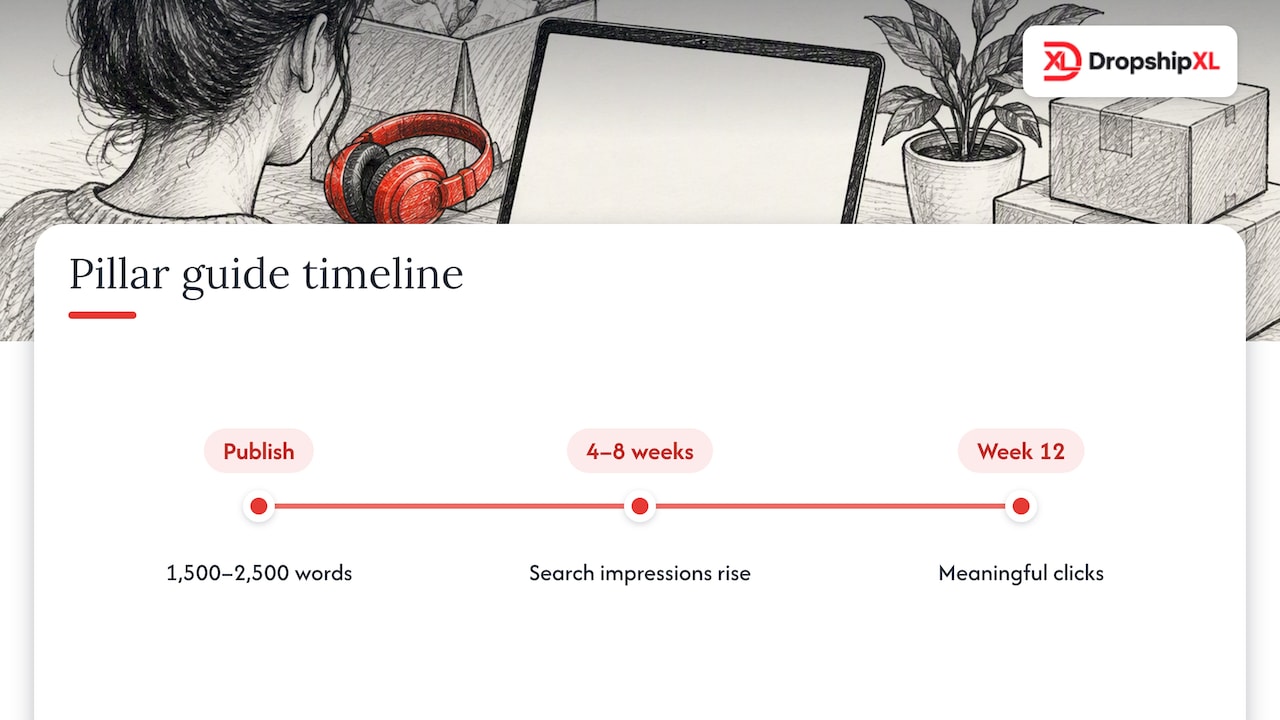
Pick your store’s core niche and write a 1,500 to 2,500 word guide that answers every major question a buyer has before they purchase. A kitchenware store selling air fryer accessories might publish “The Complete Guide to Air Fryer Accessories” covering sizing, materials, and care.
Realistic payoff. A ranked pillar guide in a mid-competition niche typically pulls 500 to 2,000 organic visits a month on its own once established. Expect this page to start climbing in Google Search Console impressions within 4 to 8 weeks, with meaningful clicks by week 12. One strong pillar guide can produce more compounding organic traffic over 12 months than 20 thin blog posts combined.
2. Optimize your highest-margin product pages for real buyer intent
Rewrite your highest-margin product titles and descriptions around how real buyers search, not how suppliers labeled the item. Instead of “Silicone Mat Set,” use “Non-Stick Silicone Baking Mat Set for Air Fryers.” See my guide on how dropship store design increases sales for the exact edits that move rankings fastest.
Realistic payoff. A single product page rewritten around real search intent can go from 0 organic visits to 50 to 200 a month inside 6 to 10 weeks. If you have 10 priority products and apply this to all of them, the stack can produce 500 to 2,000 qualified organic visits a month at the product level alone, before any blog traffic.
3. Answer “People Also Ask” questions directly on your pages
Add a short Q&A block near the bottom of your pillar guide or product page that answers common searches in plain language. A phone accessory store could add “Do magnetic phone mounts work with heavy cases” with a two-sentence answer.
Realistic payoff. If one of your Q&A blocks wins the featured snippet or People Also Ask slot for its question, that single slot can bring 100 to 500 extra organic visits a month to the page it sits on. Expect snippets to start appearing in search results within 6 to 12 weeks.
4. Refresh or merge thin, underperforming pages
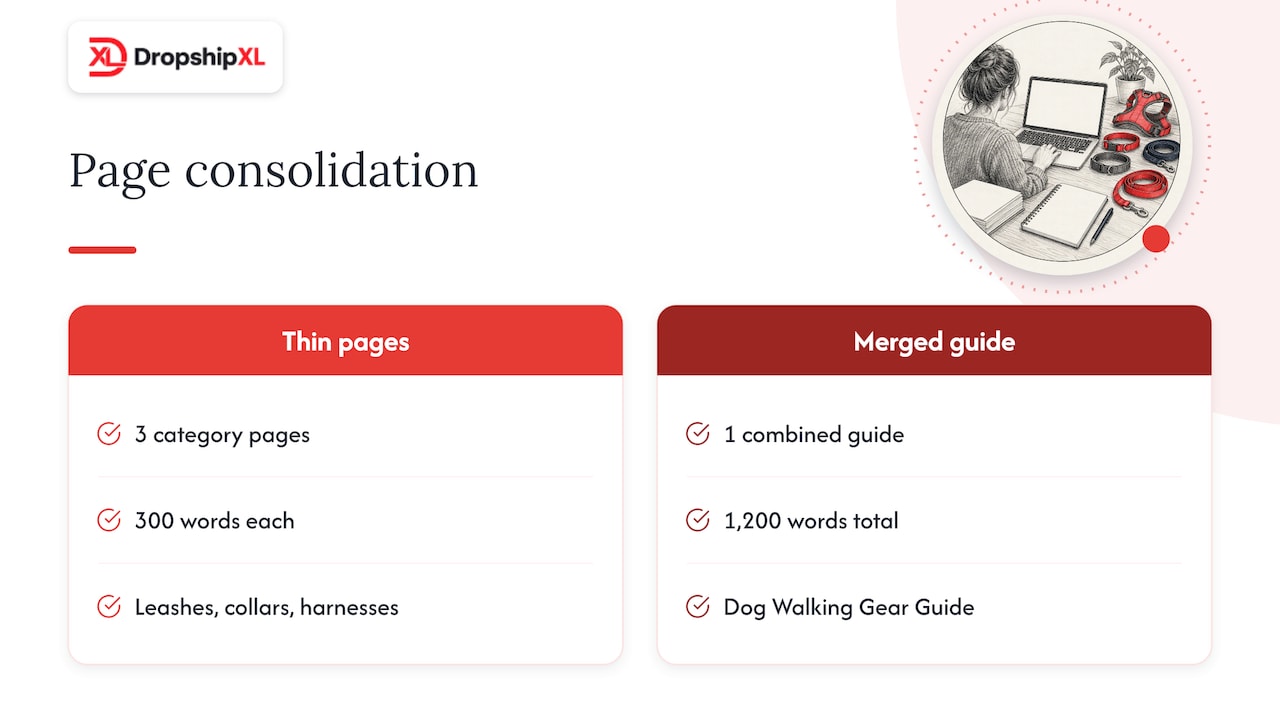
Combine three weak 300-word category pages into one strong 1,200-word guide instead of spreading your authority thin. If you run separate pages for “dog leashes,” “dog collars,” and “dog harnesses” with little content each, merge them into “Dog Walking Gear Guide” with sections for each.
Realistic payoff. Consolidation often lifts the merged page from a combined 50 to 100 organic visits a month across the thin pages to 300 to 800 a month on the single stronger page, within 4 to 6 weeks of re-indexing. Google’s own guidance on helpful, people-first content rewards this kind of consolidation over mass-produced thin pages.
5. Link your blog posts to your priority product pages
Every blog post you publish should link to the product page it is meant to support, using descriptive anchor text. A post titled “Best Gifts for Coffee Lovers” should link the phrase “pour-over coffee sets” directly to that product page.
Realistic payoff. Internal link equity flowing from 10 strong blog posts to a priority product page can lift that product page by 2 to 5 ranking positions over 4 to 8 weeks, often doubling or tripling its organic clicks. This is a same-day fix with no new content required.
Mentor Tip. I have my students batch their content calendar around one niche at a time so every new page reinforces the last. Scattering effort across unrelated topics is one of the fastest ways to make 20 posts feel like 2.
Fix the Technical and On-Page Issues That Block Growth
Content only works if Google can crawl, index, and reward the page fairly. A handful of technical fixes often unblock growth faster than writing anything new.
6. Audit your Search Console coverage report every week
Catch indexing errors before they cost you traffic. Fix “excluded” or “error” pages first, since those are invisible to searchers.
Realistic payoff. A new store often has 10 to 30% of its pages silently excluded from the index. Recovering those pages can add back hundreds of monthly impressions within days of re-submission, with click-throughs following as rankings settle over 2 to 4 weeks.
7. Check Core Web Vitals and compress oversized images
Page experience signals, including loading speed, contribute to how content performs in search. Shrinking a 3MB hero image to under 200KB often improves Largest Contentful Paint within days.
Realistic payoff. Moving from “poor” to “good” Core Web Vitals on mobile can lift rankings 2 to 5 positions on competitive product queries. On a page already getting 300 impressions a month, that often doubles clicks within 4 to 6 weeks because higher positions have far higher click-through rates.
8. Defer noncritical scripts
Defer scripts like chat widgets and review plugins so they load after the main content. That helps your Interaction to Next Paint score on mobile.
Realistic payoff. On a slow store, deferring scripts can cut mobile load time by 1 to 3 seconds, which lifts bounce-rate-adjusted ranking signals and often recovers 10 to 20% of previously lost mobile clicks within 2 to 4 weeks.
9. Rewrite title tags to match search intent
Rewrite title tags to match search intent, not just your product name. “Buy Yoga Mat” becomes “Non-Slip Yoga Mat for Hot Yoga, Free Shipping.”
Realistic payoff. Title-tag rewrites on a page already ranking in the top 20 commonly lift click-through rate by 20 to 40%. On a page getting 1,000 impressions a month, that can mean 20 to 50 extra organic clicks a month without any new content, visible within 2 to 3 weeks.
10. Add structured data for products and FAQs
Add structured data for products and FAQs so search engines can display star ratings, prices, and answers directly in results. For the full page-level framework, see my store design conversion guide.
Realistic payoff. Rich results (star ratings, prices, FAQ accordions) commonly double a product page’s click-through rate against competitors who do not have them. On a page getting 500 impressions a month at a 2% CTR, that lifts clicks from 10 to 20 a month per page, every month, from a one-time setup.
11. Set canonical tags on duplicate product variants
Set canonical tags on any duplicate product variants (color or size variations, for example) so you are not splitting ranking signals across near-identical URLs.
Realistic payoff. A product with 5 color variants splitting rankings across 5 URLs can consolidate those signals onto one canonical URL and jump 3 to 10 positions in 2 to 4 weeks. That often moves a page from “almost ranking” (page 2) to real traffic (page 1).
12. Check your robots.txt file
Confirm you are not accidentally blocking category or product pages from being crawled. This is a surprisingly common issue after a theme change.
Realistic payoff. If your robots.txt is blocking entire sections, this is a 5-minute fix that can unblock hundreds of pages from crawling. I have seen stores recover 1,000+ monthly organic clicks within 2 to 3 weeks of fixing a single bad line. For how fulfillment speed also feeds into page experience signals, see my guide on how to fulfill dropshipping orders.
Turn Social Posts Into Clicks and Backlinks
Social platforms do not hand you rankings directly. They generate the clicks, shares, and backlinks that search engines notice over time.
13. Repurpose your pillar guide into a short video or carousel
Turn “The Complete Guide to Air Fryer Accessories” into a 60-second video showing three accessories in use, with a link to the guide in your bio or caption.
Realistic payoff. A single repurposed short video that hits moderate reach (50,000 to 200,000 views) commonly drives 500 to 2,000 clicks to the linked pillar guide over the week after posting, plus a steady long-tail trickle for months. One viral post can outperform a month of blog posts for direct referral traffic.
14. Collect and share real customer photos as social proof
A phone case store reposting a customer’s unboxing video, tagged and credited, builds the kind of shareable content that strangers actually trust.
Realistic payoff. UGC posts commonly produce 2 to 4x the engagement of brand-made content, which both the social algorithms and search engines notice over time. Expect 200 to 500 extra qualified clicks a month once you have 10 to 15 real customer photos circulating on your product pages and social accounts.
15. Run small collaborations with micro-influencers in your niche
Send a product to a creator with a few thousand followers in exchange for an honest review post. This is often free or low-cost compared to large sponsorships.
Realistic payoff. A single micro-influencer post from an account with 10,000 to 50,000 engaged followers commonly drives 200 to 1,000 referral visits over the week after posting. The resulting backlink or social mention also feeds search rankings over the next 1 to 2 months. See my TikTok marketing guide for the full playbook.
16. Track which posts drive clicks back to your site
Then double down on that format. If a reel showing your product solving a specific problem outperforms a static product photo, make more reels.
Realistic payoff. Doubling down on your highest-performing social format often doubles total referral clicks within 30 days, because you are concentrating effort on the format the algorithm already rewards for your audience. This is a measurement move with compound returns.
When a Google Business Profile Actually Helps Your Store
Most dropship stores operate without a storefront. If you have any local footprint — a pickup location, a returns address customers visit, or a local service add-on — a Google Business Profile is worth setting up.
17. Decide if you qualify first
A Business Profile is meant for businesses with a real-world presence or service area, not a purely online store with no physical touchpoint.
Realistic payoff. If you qualify, a complete local profile can bring 50 to 500 extra local organic visits a month. If you do not qualify, skipping this channel saves you the hours this would otherwise take and lets you invest them in content and technical fixes with better upside.
18. Verify and complete every field
Fill out category, hours, website URL, and product photos. Completeness ties directly to prominence in local results.
Realistic payoff. Moving from a half-complete profile to a fully complete one often doubles local map impressions within 2 to 4 weeks, translating to 25 to 100 additional monthly local clicks on top of any existing baseline.
19. Add product listings to your profile
If you sell anything customers might search for locally, give Google more context about what you offer by adding products.
Realistic payoff. Product listings surface your store on local product queries you were not ranking for before. Expect 20 to 100 extra qualified clicks a month per product category once Google is indexing those listings, usually within 3 to 6 weeks.
20. Respond to every review
Positive or negative. Active engagement is one of the signals Google highlights for improving local visibility.
Realistic payoff. Stores that respond to 100% of reviews commonly outrank similar profiles with the same star count on local queries, which can lift local clicks by 15 to 30% over 6 to 8 weeks. The time cost is 10 to 15 minutes a week.
21. Account for propagation delays
Profile edits can take a few days to appear. New profiles typically take several weeks to establish meaningful local rankings. If US-based sourcing is part of your local story, the Watchman Advisors US dropshipping suppliers directory is where I point students who want faster domestic shipping.
Realistic payoff. No direct traffic from this tactic itself. The payoff is avoided frustration. Knowing the timeline keeps you from giving up two weeks before results would have landed, which is when most store owners quit this channel too early.
Earn Links Through Real Community and Partnership Outreach
Backlinks still matter. The fastest way to earn them without a budget is to build real relationships with people who already serve your audience.
22. Find niche blogs and small creators your buyers already follow
A pet supply store might search for “best dog toys blog” and compile a list of ten sites that review products in that space.
Realistic payoff. A targeted outreach list of 20 niche blogs typically converts to 2 or 3 published backlinks, each bringing 50 to 500 referral visits a month plus ongoing SEO lift. One quality roundup placement can produce more compounding traffic than six months of generic social posting.
23. Offer a free product in exchange for an honest review
This costs you the product and shipping, nothing else. It often results in a dofollow link back to your product page.
Realistic payoff. Expect roughly 1 placed review per 5 to 10 products you send. Each review commonly produces 50 to 300 referral visits in the first 90 days and a long-tail dofollow backlink that keeps feeding rankings for 12 months or more.
24. Co-create content with a complementary store
A phone accessory store might partner with a car organization brand on a joint “car commute essentials” guide, each linking to the other.
Realistic payoff. A co-created guide shared across both audiences commonly brings 200 to 800 new referral visits in the first 30 days, plus a reciprocal backlink that lifts rankings on both sides over 2 to 3 months. For how your supplier relationships make these partnership offers credible, see my role of suppliers in dropshipping guide.
25. Participate in relevant forums and communities without pitching
Answer questions on niche subreddits or Facebook groups, linking to your content only when it genuinely helps, never as a drive-by promotion.
Realistic payoff. A single genuinely helpful reply in an active niche community commonly produces 50 to 200 referral clicks over the following week, with the top-voted replies continuing to pull long-tail traffic for months. Three hours a week of real participation can produce the same referral volume as a $200 monthly ad spend.
Mentor Tip. I have my students keep a simple spreadsheet tracking who they contacted, what they offered, and the result. That one habit shows you which value exchange actually converts into links, instead of guessing.
Set Up the Free Dashboard That Shows What Works
You cannot improve what you do not measure. The tools that matter most here cost nothing.
26. Verify your site in Google Search Console
Access query data, indexing status, and manual action alerts. This is the tool Google itself recommends for monitoring organic performance.
Realistic payoff. No direct traffic from the tool itself. The payoff is seeing exactly which queries your pages are already ranking for, which commonly reveals 10 to 30 “almost ranking” keywords you can optimize for and gain 100 to 500 additional organic clicks a month inside 60 days.
27. Connect Google Analytics (GA4)
Track sessions, engagement rate, and conversion behavior once visitors land on your site.
Realistic payoff. GA4 shows which organic landing pages actually convert, which lets you concentrate content effort on the pages that already produce buyers. Reallocating effort based on GA4 data commonly lifts total converting traffic by 30 to 50% over 90 days without any new content.
28. Link both to a free Looker Studio dashboard
See clicks, impressions, click-through rate, top queries, and landing pages in one combined view.
Realistic payoff. A combined dashboard cuts weekly reporting time from 60 minutes to 10, which is the difference between actually checking the data every week and skipping it. The returns compound through better decisions, not more traffic directly.
29. Diagnose traffic drops methodically
Check Search Console’s coverage report for new errors. Confirm there is no manual action. Review any recent theme or plugin changes before assuming a ranking penalty.
Realistic payoff. Methodical diagnosis commonly identifies the real cause of a traffic drop inside 48 hours. Recovery after a fix typically restores 70 to 100% of lost traffic within 2 to 4 weeks, versus months of guesswork if the real cause goes unfixed.
| Metric | Where to find it | Recommended check-in |
|---|---|---|
| Clicks and impressions | Search Console performance report | Weekly |
| Top queries and landing pages | Search Console performance report | Weekly |
| Engagement rate and sessions | GA4 | Weekly |
| Index coverage and manual actions | Search Console | Weekly, or immediately after a traffic drop |
Use Small Paid Budgets Only to Amplify What Already Works
Once your free tactics are in motion, a small paid budget can speed up results. It should support your content rather than replace it.
30. Put a small budget behind your best-performing pillar guide
Generate initial traffic and shares. That can lead to organic backlinks once more people discover the page. For the paid-channel decision, see my Google Ads versus Meta Ads breakdown.
Realistic payoff. $100 to $300 in paid promotion behind a strong pillar guide can bring 2,000 to 5,000 early readers, which typically produces 3 to 10 natural backlinks over the following 60 days. Those backlinks then feed organic rankings long after you stop spending, often adding 500 to 2,000 organic visits a month to that page for the next 12 months.
Treat paid promotion as a bridge, not a foundation. The organic tactics above are what keep paying off after you stop spending. For how retargeting fits into a full channel mix, see my guide on why repeat buyers matter.
What 17 Years of Mentoring Dropshippers Has Taught Me
I have watched a consistent pattern across the 3,270+ students I have mentored. The stores that win organically are the ones that treat content and technical fixes as a system, not a scramble. Every channel above maps to a piece of a systematic process that starts with the right niche and product pages, builds content around real buyer questions, fixes technical issues, then amplifies through social and partnerships.
Pick one tactic from this list, the one that feels most doable this week, and execute it before moving to the next. Momentum compounds faster than perfection. For how to pair this work with the right product in the first place, see my steps to validate a profitable dropshipping niche.
How I Help Students Turn Traffic Into Sales
Executing all 30 tactics above takes time most store owners do not have. That is exactly why I built done-for-you options alongside the mentoring.

My MVP PRO Dropship Design Package handles the product page design and structure so your SEO and content efforts convert visitors effectively instead of leaking out the door. For readers who want ongoing guidance across all seven steps of my process, not just the design piece, book a Free 30-minute dropship mentoring call with me and we will map out the moves that matter most for your store right now.
FAQ
How can I increase my organic reach
Focus on publishing content that directly answers what your buyers are searching for. Then fix technical issues like slow load times and poor mobile experience that quietly suppress rankings. Monitor progress in Search Console so you know which pages are gaining impressions before you invest more time.
What is the best source of organic traffic
For most small stores, a well-optimized pillar guide combined with clean technical SEO produces the most reliable organic traffic over time. Google’s own guidance on helpful, people-first content emphasizes depth and usefulness over volume. That favors a few strong pages over many thin ones.
How do I increase organic visibility
Improve on-page elements like title tags, headers, and internal links so both users and search engines understand what each page covers. Adding structured data for products and FAQs can also help your pages display more prominently in search results.
How do I get free organic traffic
Publish niche-specific content, fix technical SEO issues, and promote that content through social media and community engagement. All of that costs time rather than money. Paid promotion can accelerate results once you have strong content, but it is not required to start seeing organic gains.
How long does it take to see organic traffic results
Technical fixes often show up in indexing reports within days to a couple of weeks. Content and link-building benefits typically take 6 to 12 weeks to show meaningful ranking movement. Local listing changes can take several weeks to establish, since Google needs time to verify and rank a new or updated profile.
Pick one tactic. Do it this week. Then stack the next one. In that order. — Trent

Here are 4 other ways I can help you when you're ready: