
This article walks you through 15 proven traffic strategies for pulling at least 500 qualified daily customers to your online business, with a clear example under every strategy showing how a store owner can scale that specific tactic up to that number.
You will also see which two to start with when you have ad budget, which two to lean on when you do not, and the 90-day sequence I give every new student instead of trying all 15 at once.
The reason I framed this piece around 500 qualified daily customers is simple. A number that specific forces a plan. A vague goal of “more traffic” does not.
On that exact point, I think of what James Clear has written about the gap between what we want and the systems that actually get us there.
“You do not rise to the level of your goals. You fall to the level of your systems.” — James Clear
500 qualified daily customers is the goal. The 15 strategies below are the systems that produce it. Launch day silence is brutal. You built the store, picked the products, wrote the descriptions, and hit publish. Then you refresh your analytics dashboard like a crowd is about to show up. It will not, not yet. Every store that gets 500 qualified daily customers started exactly where you are. Zero history. Zero backlinks. Zero trust with Google.
The fastest way to that number is a mix of targeted paid ads and direct community outreach to pull in real buyers this week, while you build search engine optimization and content as the engine that keeps working months from now. If you have ad budget, start with paid search or paid social plus one content channel. If you do not, lean on organic social and community outreach while you build content consistently. Either path, aim for your first 100 to 300 qualified visitors in the first two to four weeks. Then stack the strategies below to climb toward 500 a day.
The 15 Proven Ways to Reach 500 Qualified Daily Customers
1. Search Engine Optimization That Earns Buyer-Intent Clicks
SEO means structuring your pages so Google ranks you for the exact searches your buyers type. It is the most sustainable free traffic channel. It rewards patience over speed.
- Pick one primary keyword per product or collection page, the exact phrase your buyer searches.
- Put that keyword in your title tag, H1, URL, and first sentence.
- Write unique product descriptions. Never paste supplier copy.
- Fix technical basics. Compress images. Add alt text. Submit your sitemap in Google Search Console.
- Build 2 to 3 blog pages around buyer questions tied to your niche.
How this gets you to 500 qualified daily customers. A new store targeting “self-watering ceramic planter” writes 25 keyword-optimized product pages plus 20 answer-shaped blog posts over 6 months. Each page averages 15 to 30 qualified visits a day once ranked, which stacks to a steady 500+ qualified daily customers from organic search alone. The math: 45 pages times about 12 visitors a day each. It takes 4 to 6 months to climb there, but it keeps producing without ad spend after that.
Time and cost. Free if you do it yourself. 2 to 4 hours per week. 3 to 6 months before you see real volume. For the on-page fixes that move rankings fastest, see my guide on how dropship store design increases sales.
2. Content Marketing That Pulls Buyers Before They Decide
Content marketing means publishing helpful articles, guides, and videos that answer the questions your buyers already search. It pulls them to your site before they are ready to buy.
- List 10 questions your ideal buyer searches before purchasing.
- Write one article per week answering a single question in plain language.
- Link each article back to the relevant product or collection page.
- Repurpose each article into a short social post or video script.
- Update your best-performing post every few months with fresh details.
How this gets you to 500 qualified daily customers. A phone accessory store publishes 52 answer-shaped posts in a year, one per week. Three or four hit well and pull 100 to 150 qualified daily readers each. Combined with the long tail of the other 48 posts, the blog alone brings in 500+ qualified daily customers who clicked through to a product page from an article matched to their exact question.
Time and cost. Free if you write it yourself. 2 to 3 hours per post. Or $50 to $150 per article if you hire a freelance writer. Results build over 2 to 3 months, then compound.
3. Email Marketing and Opt-Ins That Bring Customers Back Daily
Email marketing means collecting visitor emails with an incentive and sending them back to your store through automated sequences. It is one of the highest-return channels available to ecommerce stores.
- Offer a 10% discount or free guide in exchange for an email on your homepage pop-up.
- Connect an email tool and build a 3-email welcome sequence.
- Send one weekly broadcast featuring a product, tip, or story.
- Set up an abandoned-cart email.
- Segment buyers from non-buyers after 30 days and message them differently.
How this gets you to 500 qualified daily customers. A skincare store grows its list to 10,000 engaged subscribers over 6 months by converting 5% of site traffic to email signups. A weekly broadcast with a 25% open rate and a 10% click-through on 10,000 subscribers divided across 7 days produces about 500 qualified daily customers returning from email alone, plus the automated welcome and cart sequences layered on top. For how this ties to repeat buying, see my why repeat buyers matter guide.
Time and cost. $0 to $20 per month for most starter email tools. 2 to 3 hours to set up sequences. Every commercial email needs a clear opt-out and your real business address under the FTC’s CAN-SPAM rules. Opt-out requests must be honored within 10 business days.
4. Organic Social Media Posting Where Your Buyer Already Scrolls
Organic social posting means publishing on Instagram, TikTok, Facebook, or Pinterest without paying to boost it. You build an audience one post at a time.
- Pick the one platform where your buyer already spends time.
- Post 3 to 5 times per week showing the product in use, not just product photos.
- Use 3 to 5 relevant hashtags or keywords per post.
- Reply to every comment within 24 hours to build engagement signals.
- Pin your best post or add your store link in your bio consistently.
How this gets you to 500 qualified daily customers. A kitchen gadget store grows its Instagram following to 50,000 engaged followers over 9 months by posting daily video of the product in use. At a 2% weekly link-click rate across 50,000 followers, with 3 posts a week pulling link traffic, that produces 500+ qualified daily customers from organic social alone, especially after one or two posts catch algorithmic lift.
Time and cost. Free. 3 to 5 hours per week. Results are unpredictable. Treat this as a fast-but-unreliable channel.
5. Paid Search Advertising for Immediate Buyer-Intent Traffic
Paid search means running Google Ads that show up when someone types a buying-intent keyword, like “buy wireless phone charger.”
- Start with a single campaign targeting 5 to 10 tightly related keywords.
- Set a daily budget you are comfortable losing while testing. Often $10 to $20 a day to start.
- Write ad copy that matches the exact search intent, not generic branding.
- Send traffic to your product page, never your homepage.
- Check performance after 3 to 5 days and pause anything with no clicks.
How this gets you to 500 qualified daily customers. A phone case store scales a proven Google Ads campaign to a $500-a-day budget on buyer-intent keywords with a $1 average cost per click. That pulls 500 qualified daily customers directly to product pages at the moment they are searching to buy. The economics only work if your margin covers that CPC. Prove the funnel at $20 a day first, then scale. Compare Google and Meta carefully with my Google Ads versus Meta Ads breakdown.
Time and cost. $150 to $300 to validate. Scale to $300 to $600 a day when the funnel is proven. A few hours weekly managing bids.
6. Paid Social Advertising on Platforms Built for Discovery
Paid social means running ads on Instagram, Facebook, or TikTok that interrupt someone’s scroll with your product. Targeting runs on interests, not search intent.
- Create one ad set targeting an interest closely tied to your product’s buyer.
- Use a short video or carousel, not a single static image.
- Budget $10 to $20 a day minimum for the algorithm to learn.
- Let it run 3 to 4 days before judging results.
- Kill underperforming ads and double down on whichever creative gets the most clicks.
How this gets you to 500 qualified daily customers. A fitness accessory store finds a winning video ad after testing 10 creatives at $20 a day each. The winner costs $0.80 per link click to a product page. The store scales it to $400 a day and brings in 500 qualified daily customers from paid social alone. The key is scaling only after the funnel converts at a CPA your margin can absorb.
Time and cost. $150 to $300 for a fair first test. $400 a day to hit the 500-customer target once proven. 2 to 3 hours to set up each ad.
7. Google Shopping Ads That Put Your Product in Front of Buyers
Google Shopping ads show your product photo, price, and store name directly in search results. They attract buyers further along in deciding to purchase.
- Create a free Google Merchant Center account.
- Upload a product feed with accurate titles, images, and prices.
- Link Merchant Center to a Google Ads account.
- Launch a Smart Shopping or Performance Max campaign with a small daily budget.
- Review which products get impressions and pause ones with zero traction after a week.
How this gets you to 500 qualified daily customers. A home decor store uploads 50 products, finds the 5 that get the most clicks, and concentrates spend there. At $300 a day with a $0.60 average CPC on Shopping Ads, the store pulls 500 qualified daily customers who are already comparing products to buy. Shopping clicks are often cheaper than search text ads for the same buyer intent.
Time and cost. $15 to $25 a day to validate. $200 to $400 a day at the 500-customer target. Half a day to build the feed correctly the first time.
8. Retargeting Ads That Bring Earlier Visitors Back to Buy
Retargeting shows ads to people who already visited your site but left without buying. It is one of the more efficient ad types available because retargeting ads typically carry a lower cost-per-click than cold-traffic ads.
- Install the Facebook Pixel and Google Ads tag before running any other ads.
- Build an audience of visitors from the last 30 days who did not purchase.
- Create a simple ad reminding them of the product they viewed, maybe with a small discount.
- Set a modest budget. $5 to $10 a day is enough early.
- Let it run continuously alongside your other campaigns.
How this gets you to 500 qualified daily customers. A bag store builds a retargeting pool of 25,000 recent site visitors over 90 days by combining tactics 5 through 7 above. A $50-a-day retargeting campaign to that warm audience at a $0.10 CPC pulls 500 qualified daily customers back to the store at a fraction of the cost of acquiring cold traffic. Retargeting multiplies every other channel.
Time and cost. $5 to $10 a day while small. $50 a day once your visitor pool supports it. An hour to set up.
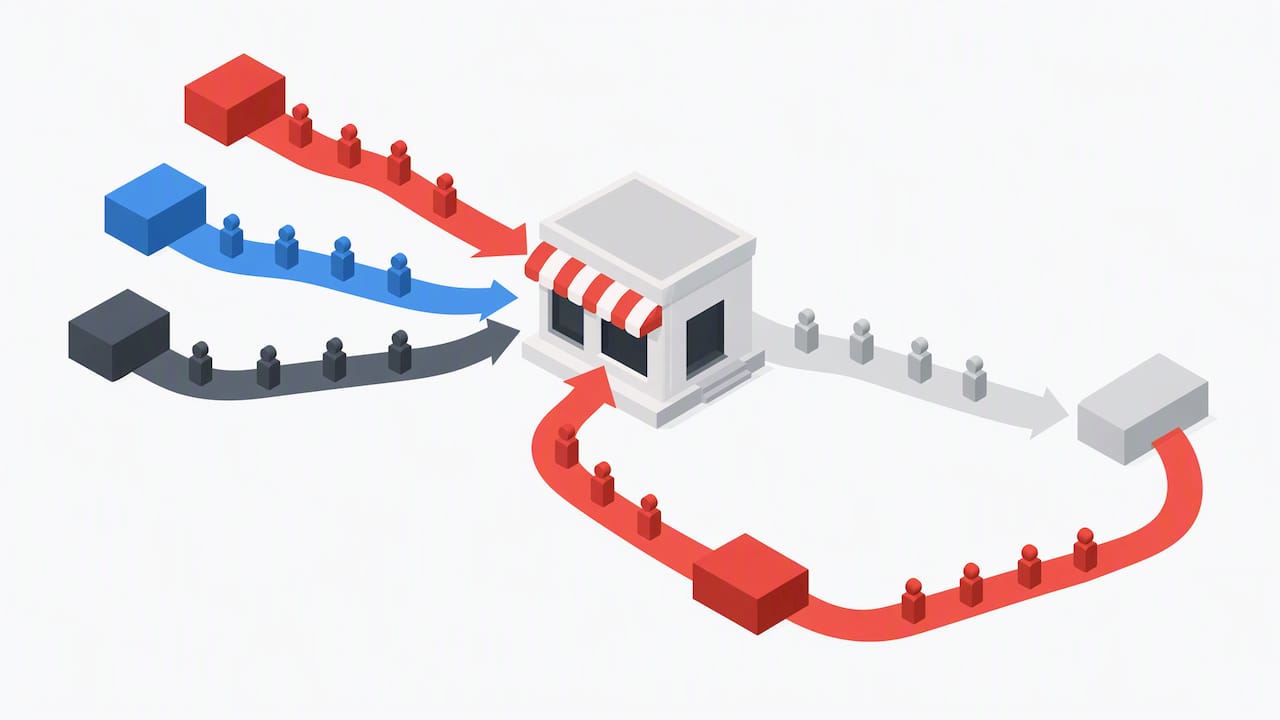
9. Micro-Influencer Outreach That Produces Trusted Traffic Spikes
Micro-influencer outreach means sending free product or a small fee to creators with a focused, engaged following. Usually a few thousand to a few hundred thousand followers. In exchange for an honest post or video.
- Search your product’s hashtag on Instagram and TikTok to find creators already talking about similar items.
- Message 15 to 20 creators offering a free product for an honest review, no script required.
- Expect a 10 to 20% response rate. Cast a wide net.
- Give them a unique discount code so you can track resulting sales and traffic.
- Repost their content on your own channels with credit.
How this gets you to 500 qualified daily customers. A pet accessory store partners with 10 micro-influencers in the dog-training niche over a quarter. Each posts a video averaging 25,000 views with a 2% link-click rate, producing 500 qualified clicks per post. Staggered weekly across the quarter, the store averages 500 qualified daily customers from the ongoing creator cycle, with each post also feeding retargeting pools and social proof.
Time and cost. Mostly product cost. $200 to $1,000 total for a quarterly program. A few hours of outreach messaging per week. Results take 2 to 4 weeks per creator to show up.
10. Affiliate and Referral Programs That Turn Fans Into Promoters
An affiliate or referral program pays other people a commission or reward for sending you traffic and sales. It turns happy customers and partners into a sales force.
- Set a commission rate. Commonly 10 to 20% of sale value.
- Use an app or plugin to generate unique tracking links for each affiliate.
- Reach out to 10 to 15 relevant bloggers, creators, or past customers to join.
- Give new customers a referral code to share with friends for a discount on both sides.
- Pay out promptly so affiliates stay motivated.
How this gets you to 500 qualified daily customers. A supplement store builds a network of 50 active affiliates over 6 months. Each affiliate sends an average of 10 qualified daily customers through their tracked links. The resulting referral traffic converts at a noticeably higher rate than cold ads because it comes with built-in trust, and the entire 500-customer flow is funded by the commissions on the sales those affiliates produce.
Time and cost. $10 to $30 a month for tracking software. Plus commission payouts tied to actual sales. 2 to 3 months before steady volume. Close to self-funding once it works.
11. Guest Posting and Backlink Outreach That Builds Lasting Authority
Guest posting means writing an article for someone else’s established blog in exchange for a link back to your store. It earns referral traffic and signals trust to search engines.
- Find 10 to 15 blogs in your niche that accept guest contributors.
- Pitch a specific article idea, not a generic “can I write for you.”
- Write a genuinely useful post with one natural link back to your store.
- Follow up once after a week if you do not hear back.
- Track referral traffic from each published post in your analytics.
How this gets you to 500 qualified daily customers. A sustainable kitchenware store publishes 20 guest posts across the first year on blogs reaching the zero-waste audience. The backlinks lift SEO rankings on 15 core keywords, and the direct referral trickle from the posts combines with the SEO lift to produce 500 qualified daily customers 12 to 18 months in. This is a long-horizon tactic that compounds, not a quick push.
Time and cost. Free other than writing time. 2 to 4 hours per pitch and article. 1 to 2 months per placement.
12. Community and Forum Outreach, Including Reddit
Community outreach means showing up in Facebook Groups, niche forums, and subreddits where your exact buyer already hangs out. You answer questions and add value instead of dropping your link everywhere.
- Join 3 to 5 communities where your target buyer is active.
- Spend a week just reading and answering questions with zero self-promotion.
- Once you have credibility, answer a relevant question and mention your product only when it is a genuine fit.
- Never mass-post the same link across multiple subreddits in one day.
- Ask early visitors for honest feedback rather than shares.
How this gets you to 500 qualified daily customers. A board game accessory store becomes a known helpful voice in two tabletop subreddits over 6 months. The owner’s product mentions (always in response to a direct ask) and the pinned user-written review posts combine to drive 500 qualified daily customers from the two communities, with no ad spend. Community reach caps out eventually, which is why this stacks with paid channels rather than replacing them.
Time and cost. Free. 3 to 5 hours per week of genuine participation. Treat Reddit with care, since communities have strict no-self-promotion rules.
13. Short-Form Video on YouTube Shorts and TikTok
Short-form video means creating quick demo, unboxing, or problem-solution clips that live on platforms built around discovery. It can reach people who have never heard of your brand.
- Film your product solving one specific problem in under 30 seconds.
- Post consistently, 3 to 4 times a week.
- Hook viewers in the first 2 seconds with the problem, not your logo.
- Add captions since most people watch with sound off.
- Include your store link in your bio and pin it in your first comment.
How this gets you to 500 qualified daily customers. A car accessory store posts 180 short videos across 6 months. One hits big with 2 million views, and 20 others pull between 50,000 and 500,000 views each. At a conservative 0.5% click-through to the store, the backlog of videos combined with the viral spike pulls 500+ qualified daily customers for months after. See my TikTok marketing guide for the full playbook.
Time and cost. Free to film with a phone. Editing apps $0 to $15 a month. Unpredictable results.
14. Product Page Optimization That Converts the Traffic You Already Have
Product page optimization means making sure the visitors you already have convert into buyers. Site speed, mobile design, and clear calls to action affect both rankings and conversion. A flood of traffic to a weak page wastes every other tactic.
- Rewrite your headline to state the benefit, not just the product name.
- Add 3 to 5 real photos showing the product in use.
- Move your “add to cart” button above the fold on mobile.
- Add 2 to 3 lines addressing the most common objection buyers have.
- Test one change at a time and track conversion rate for a week before changing another element.
How this gets you to 500 qualified daily customers. A phone accessory store is already pulling 400 daily visitors from tactics 5, 6, and 8 but only converting 2% to a qualified next step. A product page rewrite that addresses the top buyer objection and adds in-use photos lifts qualified clicks to the checkout to 4%, which effectively doubles qualified daily customers to 500+ without a dollar more in ad spend. See my store design conversion guide for the exact fixes.
Time and cost. Free if done yourself. 2 to 3 hours. The fastest-return item on the list.
15. Analytics That Show Which Strategies Earn More of Your Time
Analytics means tracking where your visitors come from and what they do once they land. That tells you which of the previous 14 strategies deserve more of your time and money.
- Install Google Analytics 4 and connect it to your store before launching any traffic tactic.
- Set up goal tracking for purchases, email signups, and add-to-cart events.
- Check your traffic sources weekly.
- Compare conversion rate by channel, not just visitor count.
- Cut whatever channel shows consistent zero results after a fair test window.
How this gets you to 500 qualified daily customers. A candle store running 8 strategies at once reviews GA4 weekly and sees that Reddit outreach and Google Shopping produce qualified traffic at 4x the rate of Facebook retargeting and guest posting. The owner cuts the two weak channels and reinvests that time and budget into the two strong ones. Within 60 days, qualified daily customers climb from 220 to 500 because the capital is now concentrated in channels that actually convert.
Time and cost. Free. 30 minutes a week to review. Skipping measurement means guessing which strategies are worth repeating.
Why Site Speed and Mobile Design Decide Who Converts
A beautiful store that loads slowly on a phone loses visitors before they ever see your product. Most of your traffic from social, search, and ads lands on a phone screen first. Site speed and mobile design affect both your search rankings and how many visitors actually convert.
Compress every product image before uploading. Remove apps and widgets you are not actively using. Test your store on your own phone over regular cell data. Check your mobile checkout flow since that is where slow load times cost the most sales. A page that takes 5 seconds to load on mobile loses far more qualified customers than one that loads in 2.
This costs nothing but an afternoon of testing and cleanup. Every other traffic strategy on this list performs better once the page it points to loads fast and works cleanly on a phone.
Local SEO and Google Business Profile for Regional Reach
If your dropshipping store ships from a specific region, serves a local market, or you want local credibility signals, claiming and optimizing a free Google Business Profile adds another discovery path, even for an online-only store.
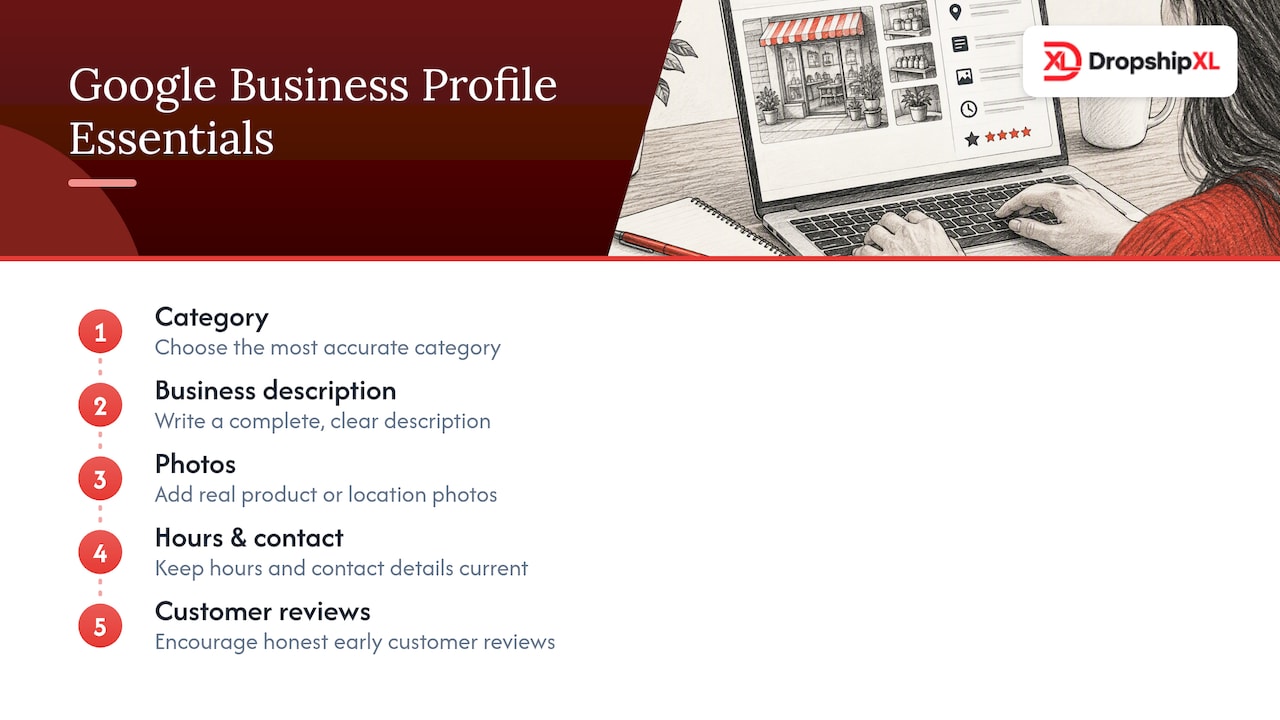
Claim your free Google Business Profile. Fill out every field completely, including category and business description. Add real photos. Keep your hours and contact details current. Encourage early customers to leave honest reviews.
For a pure online store with no physical presence, this strategy matters less than the others on this list. Treat it as a minor addition rather than a priority. If a US-only angle matters for your suppliers, see the Watchman Advisors US dropshipping suppliers directory for domestic sourcing options.
Customer Photos and Reviews That Build Trust at Scale
User-generated content means real customer photos, videos, and reviews that you repost and feature. It builds trust with new visitors and gives you free content to post.
Ask every customer for a photo review in your post-purchase email. Offer a small discount on their next order as a thank-you. Repost the best ones on your product pages and social accounts, always with credit. Feature a rotating customer photo section near your reviews.
This costs nothing but a little outreach time and a small incentive budget, maybe $5 to $10 per customer who shares a photo. Once you have 10 to 15 genuine photos, your product pages convert better and you have a steady stream of content to post without filming anything new.
Chatbots and Interactive Features That Keep Visitors on the Page
A simple chatbot or interactive quiz keeps visitors engaged long enough to find what they need instead of bouncing after 10 seconds. This does not drive new traffic. It keeps more of the traffic you already paid for.
Add a basic chat widget that answers shipping, sizing, or return questions instantly. A short “find your product” quiz guides undecided visitors to the right item. Most chat and quiz apps for small stores run $0 to $30 a month and take under an hour to set up.
Layer this on top of paid ads and retargeting, where every visitor costs real money to acquire. The lift here can be the difference between 300 and 500 qualified daily customers at the same ad budget.
What to Learn by Watching the Competition
You do not need expensive tools to learn from stores doing well in your niche. Visit three to five competitor or adjacent stores regularly. Note which products they are pushing, what their ads look like, and which blog topics or videos they are publishing.
Search your main keyword and see which stores rank on page one. Check what their product pages and content cover that yours does not. Follow their social accounts to see which posts get the most engagement.
This costs nothing but an hour or two a month of observation. Once your own analytics from strategy 15 start showing patterns, lean on your own numbers over guesswork.
My Honest Take on Your First 90 Days to 500 Daily Customers
If I were coaching you through week one, I would tell you to ignore most of this list at first. Pick one channel to validate that people actually want what you are selling, usually a small paid ad test or direct community outreach, before you touch SEO or content. Fix your product page next. That is where qualified visitors you already have are quietly leaving.
Only once your page converts should you spend more on any paid channel. Then stack a second channel. Then a third. Sequence matters more than volume. A beginner who tries all 15 strategies in week one usually ends up doing none of them well, and 500 qualified daily customers stays out of reach. For the demand side, see my steps to validate a profitable dropshipping niche.
Mentor Tip. I have my students ask their first 10 contacts to check out the store and give honest feedback on the product page, not a share. You get real qualified visits and usable insight without asking anyone to spend their own social capital on an unproven store.
How I Help Students Put This List to Work
Reading a list of 15 strategies is one thing. Building the store, product page, and launch sequence that makes those strategies actually produce qualified customers is another.
My MVP PRO Dropship Design Package builds out a complete, conversion-focused store and product pages for you. Strategies like paid ads and retargeting have a page worth sending qualified customers to from day one. The full 7-step curriculum behind everything in this article walks you through niche selection, supplier sourcing, and traffic strategy with structure instead of guesswork. For the broader supplier framework, see my role of suppliers in dropshipping guide.
If you would rather talk through your specific situation first, book a Free 30-minute dropship mentoring call with me. We will map out which two strategies belong in your first 90 days based on your product and budget, and the realistic path from zero to 500 qualified daily customers.
FAQ
How fast can a brand-new store realistically reach 500 qualified daily customers
Paid ads and direct community outreach can bring the first 100 to 300 qualified daily customers within weeks. Reaching 500 a day consistently usually takes 6 to 12 months of stacking the strategies above, since SEO, content, and email all need time to compound. Stores that stack 3 to 4 strategies hit the number faster than ones that bet everything on a single channel.
What is the single best first move for someone with no budget
Organic social posting combined with genuine community outreach in forums and groups where your buyer already spends time costs nothing but your time. Adding real value in those spaces, rather than self-promoting, tends to work best for early qualified traffic.
Is it safe to promote a new store on Reddit
It can work well, but only if you participate genuinely first and avoid posting the same link across multiple communities in a short window. That pattern reads as spam and often gets accounts banned. Spend a week or two answering questions with no promotion before you ever mention your own product.
Should a beginner try all 15 strategies at once
No. Focus on two channels for your first 90 days and build consistency rather than spreading thin across everything on this list at once. Add new strategies only after your first two are producing steady qualified daily customers.
Is email marketing worth setting up on day one
Yes. Capturing emails early means every qualified visitor you earn from other strategies has a chance to come back. Automated email sequences are among the highest-return channels for ecommerce. Make sure every email includes a clear opt-out and your business address, as required under the FTC’s CAN-SPAM rules.
Pick two strategies. Fix the product page. Measure every week. Stack toward 500. In that order. — Trent

Here are 4 other ways I can help you when you're ready: