
This article walks you through what to actually check before you buy a dropshipping store, so you avoid the four places almost every bad purchase goes wrong. Revenue numbers, ad accounts, supplier terms, and paperwork. You will see how to trace every dollar of claimed revenue from the sales platform to the payment processor to the bank, why ad accounts almost never transfer and how to price that reality into your offer, how to verify suppliers directly instead of trusting a screenshot, and the paperwork that becomes yours the day you take over. By the end you will have a pre-purchase checklist you can run on any listing in under a week.
Bill Ackman said it the way a mentor would.
“The biggest mistake investors make is not sticking to their process.” — Bill Ackman
Buying a dropshipping store is an investing decision, not a shopping decision, and the sellers who get burned are almost always the ones who skipped a checklist step because the deal felt urgent. I have mentored more than 3,270 students across 17 years of ecommerce, and plenty of them came to me after a purchase went sideways. The patterns are consistent, and the fixes below are the exact ones I would walk you through in a 1-on-1 session. My guide to whether you should buy a dropship store, my dropshipping business model breakdown, and my why dropshipping builds wealth guide all pair with the system below.
What you actually get when you buy a dropshipping store
A dropshipping store has no warehouse and no inventory, so there is not much to hand over. You are typically buying a website and its theme, a domain, product listings, a brand name, social accounts, an email list, and supplier relationships. Sometimes you get a creative library of ad images and videos too.
What you usually do not get is the thing that produced the sales. Traffic, especially paid traffic, lives in ad accounts tied to the seller’s business entity. That distinction drives almost every decision below. My successful store examples and my lifestyle brand examples both show how operating stores look when their traffic engine is actually healthy.
It helps to separate two kinds of listings.
| Listing type | What it usually is | Main risk |
|---|---|---|
| Turnkey template store | A built site with products imported, little or no sales history | You are paying for design work you could get done for less |
| Operating store with sales | A site with orders, ad history, and supplier accounts | Inflated or unrepeatable revenue, plus ad accounts you cannot take with you |
Both can be fine. Neither should be bought on a screenshot.
How to verify the revenue before you trust a single dollar of it
The most important habit in any online business purchase is refusing to rely on static screenshots. They are easy to edit and easy to cherry-pick. The move is to trace revenue from the platform to the payment processor to the bank account, then to the books and tax returns.
In practice, ask for the following.
- Read-only access to the store admin, the payment processor, and every ad platform, so you see live data instead of a PDF.
- Independent exports of sales, refunds, and chargebacks, pulled while you watch or with your own login.
- Processor statements from the payment company showing deposits that match reported sales.
- Tax returns or books that agree with the above.
Then compare three numbers that sellers love to blur. Gross sales, net sales after refunds and chargebacks, and profit after ad spend, product cost, and fees. A store that shows 60,000 dollars in sales and loses money on every order is not a 60,000-dollar business. My dropshipping profit calculator guide, my ecommerce metrics guide, my conversion tracking guide, and my chargebacks guide all give you the exact numbers to pull during this check.
Look at the shape of the data as well. One viral month followed by decline tells a very different story from steady growth. Ask what happened in the best month and whether the seller can repeat it. If the answer is a single product that went viral, you are buying a past event.
Why paid traffic is the biggest hidden cost in any store purchase
Most dropshipping stores live on paid ads, and that makes the traffic engine the first thing to examine. Paid traffic dependency is the single most important disclosure in any dropship store sale, because ad accounts cannot be transferred to you.
Here is what that means for you.
- You start cold. Your new ad account has no history, and platforms typically need time to learn who buys. Expect a slower, more expensive first stretch than the seller’s numbers suggest.
- Creative fatigue is real. If return on ad spend has been sliding for several months, the product may be saturated or the ads worn out. Ask to see the trend, not a single good week.
- Your offer price should reflect the rebuild. If the seller’s profit assumes cheap, warmed-up traffic you will not have, the price is too high.
Before you buy, work out your own break-even cost per acquisition. My Facebook ads guide shows the math, and the same logic applies on every paid channel. If you cannot see a path to profit at today’s costs, the store’s history does not matter.
Mentor Tip. I have my students price the ad rebuild into every offer. Figure out what you will spend on cold ad testing in the first 60 days post-purchase, then subtract that from the price you were going to pay. Sellers who flinch at that number are telling you the deal was dependent on traffic you cannot inherit.
How to check the suppliers yourself before you sign anything
People assume dropshipping has no logistics risk because there is no warehouse. It does, and it lives with your suppliers. A business that gets most of its volume from one manufacturer with no documented alternative is a fragile asset.
Do these checks personally.
- Call or email the supplier directly. Confirm the account exists, how long it has been active, and what the current pricing is.
- Ask whether the terms transfer. Sellers sometimes hold personal or temporary rates. If the supplier will not continue them under your ownership, the margins you were shown may not survive the sale.
- Test shipping times and order accuracy. Place a few real orders, or review recent order data and complaint rates.
- Find a backup supplier for the top-selling products before closing.
- Confirm the supplier is a real source, not a reseller adding a hidden markup.
Use my supplier vetting checklist, my guide to finding dropship suppliers that actually deliver, my supplier role breakdown, and my wholesale supplier guide. All four work just as well for judging a supplier you inherit as one you choose. Sellers sourcing US-based suppliers can also get a strong backup shortlist from Watchman Advisors’ USA supplier directory, and my faster shipping guide covers how to lock in the delivery promises your new buyers will expect.
The paperwork, taxes, and compliance that become yours on day one
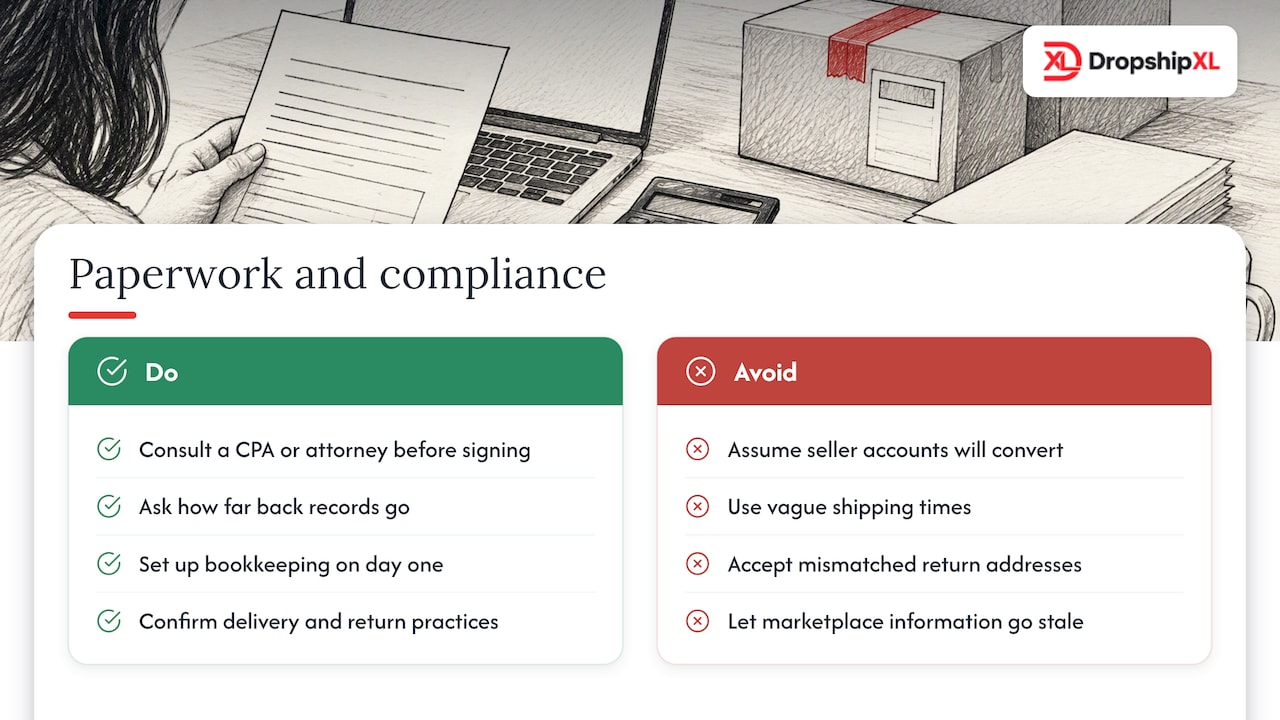
A store’s legal and tax footing becomes yours the day you take over. This is general information, so talk to a CPA or a business attorney in your state before you sign.
Records. Supporting business documents include sales slips, paid bills, invoices, receipts, and deposit slips. Ask the seller what they kept and how far back it goes. Then set up your own bookkeeping on day one. Ecommerce businesses need accurate records of gross receipts, purchases, and operating expenses, and missing documents can make it hard to back up deductions.
Business entity and tax IDs. You will likely need your own business entity, bank account, payment processor, and sales tax registration where required. Do not assume the seller’s accounts convert. Many platforms require you to open your own. My LLC for dropshipping guide, my business license guide, my resale certificate guide, and my dropshipping legality guide cover the full setup checklist.
Marketplace rules. If the store also sells on a large online marketplace, the marketplace is legally required to collect and verify bank account, contact, and tax ID information from high-volume third-party sellers, and to suspend sellers who do not keep it current. A seller account may not simply move to a new owner. My TikTok Shop policy guide, my eBay dropshipping policy guide, my Walmart Marketplace guide, and my Amazon suppliers guide cover the per-platform transfer rules.
Shipping and returns. Ask how the store handles delivery promises and customer returns. Mismatched return addresses and vague shipping times can create real problems. My returns address guide and my fraud prevention guide cover the fixes.
The red flags that should make you walk away without regret
After years of reviewing deals with students, these are the signals I take most seriously.
- The seller offers screenshots but not live, read-only access.
- No ad history or processor statements, or a long gap in the data.
- One product or one supplier drives most of the sales.
- The reason for selling is vague, or the price is a multiple of profit that ignores the traffic rebuild.
- The seller will not let you speak with the supplier.
- Reviews, social proof, or follower counts look purchased.
- A rush. Good sellers expect you to take time to verify.
One red flag can be explained. Three means you keep your money.
Mentor Tip. I have my students decide their deal-killer list before they ever read a listing. Three red flags out of your written list and you walk, no renegotiation. Deciding the rule in advance keeps emotion out of a four-figure or five-figure decision.
How to think about a fair price without a magic multiple
I will not give you a magic multiple, because it depends on the niche, the age of the store, and how repeatable the sales are. Here is the logic I teach instead.
- Start with verified net profit over at least a year, not the best month.
- Subtract what it will cost to rebuild traffic. Higher ad costs while your accounts warm up, and possibly lower conversion until you refresh creative.
- Add a cushion for supplier changes.
- Compare the result with what a new, well-built store would cost you to launch and ramp.
That last step matters. If the asking price is close to what it costs to build a better store in a validated niche, the purchase is not a shortcut. It is just a more expensive way to start. My dropshipping business plan guide, my launch checklist, and my guide to starting a dropshipping business in 2026 all show what a well-built new store actually costs.
Why I lean toward building your own store in most cases
Here is where I land, and it comes from the same seven-step process I use to build and scale my own ecommerce brand.
I would rather have you own the whole system than buy a piece of someone else’s. When you choose the niche, validate demand, and approve your own suppliers, you know why each decision was made. You do not inherit a product that peaked 6 months ago, a supplier rate that disappears, or ad accounts you cannot use. You also learn the skills that keep a store alive. Testing offers, reading ad data, and negotiating with suppliers. My dropshipping career path guide and my beginner guide to what dropshipping is both expand on the skills side.
That is not a rule against buying. Some purchases are smart, especially when the seller’s data is clean and you have the experience to rebuild the traffic. For most people starting out, though, a store they understand beats a store they merely own. Buying does not remove the work. It changes the work into detective work, and you had better enjoy it. My branded dropshipping guide and my first-sale fast guide both show how building from a validated base compares to inheriting someone else’s.
When building your own store is actually the better route
Building makes more sense when any of these are true.
- You are new and need to learn how traffic, offers, and suppliers fit together.
- The listings you find fail the checks above.
- You want a brand and niche you chose.
- Your budget is better spent on ads and testing than on a purchase premium.
Start by validating demand. My niche validation steps walk through it, my guide to finding a dropshipping supplier in 2026 covers the next step, and my should-you-buy-a-dropship-store breakdown helps you weigh purchase against build side by side. Once the store is live, my product page optimization guide, my trust badges guide, and my store design guide get the pages ready for traffic.
How DropshipXL helps you build your own store the right way
If you would rather launch a store with a proven process than gamble on a listing, I have a few ways in.
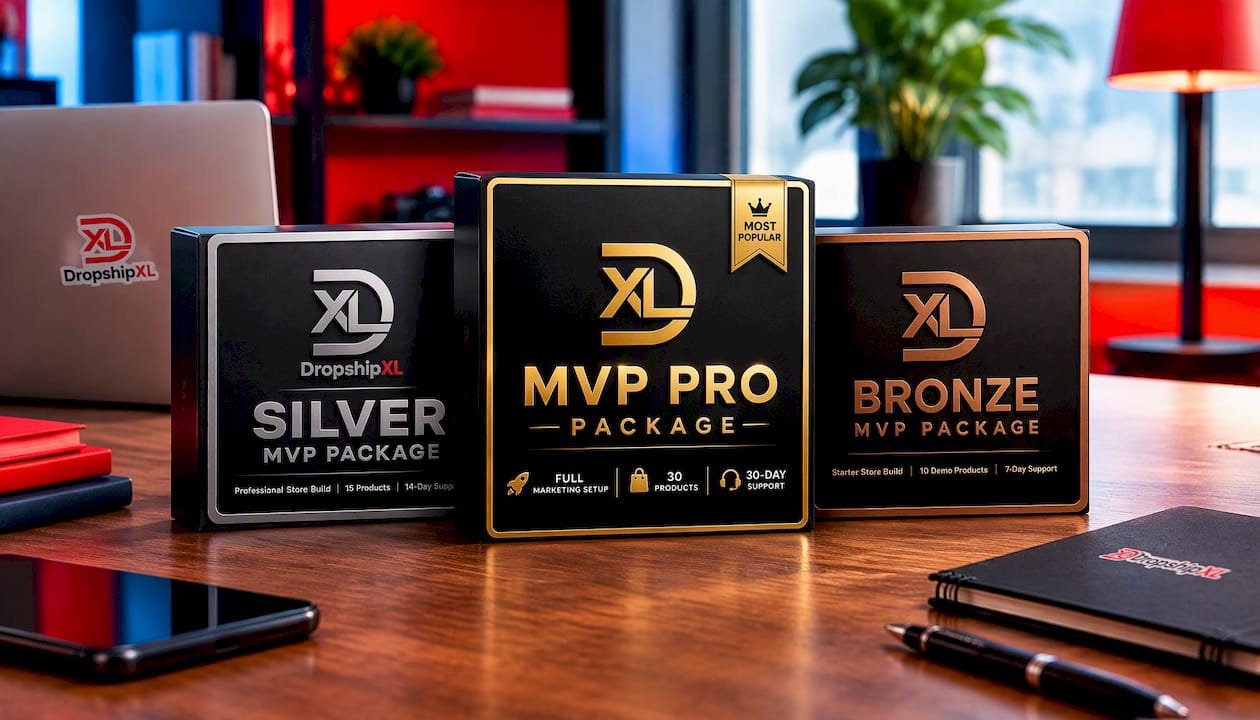
- DropshipXL Academy Membership. The structured seven-step curriculum, 997 dollars per year.
- MVP PRO Dropship Design Package. A done-for-you store built around a validated product, 2,897 dollars one-off.
- DFY Focus 1 and Mentoring package. A lighter 697-dollar starting point for a single high-converting page with direct guidance.
- Free 30-minute dropship mentoring call. Walk through your situation together before you spend anything.
- Ongoing 1-on-1 dropship mentoring. Personal guidance for buyers and builders alike.
These are the same fundamentals I use myself, applied to a store you own from day one. My scaling strategies guide covers what to do once your store is validated.
Your pre-purchase checklist to run on every listing
Print this and use it on every listing.
- Live, read-only access to the store, processor, and ad platforms.
- 12 to 24 months of exported sales, refund, and ad data that match bank deposits.
- Net profit calculated after refunds, ad spend, product costs, and fees.
- A direct conversation with each major supplier about current terms.
- A backup supplier identified for the best sellers.
- A plan and budget for rebuilding ads under your own accounts.
- Your own entity, bank account, processor, and bookkeeping ready.
- A CPA or attorney review before signing.
FAQ
How much money do you really need to buy a dropshipping store
It depends on the route. Starting a new store can cost little upfront because you do not hold inventory, but you still need money for the platform, a store build, and ad testing. Buying a store adds the purchase price on top of the ad budget you need to rebuild traffic.
Is buying a dropshipping store actually worth it
It can be, when the seller’s numbers verify from platform to bank and suppliers confirm the terms. It is a poor deal when the sales depend on ad accounts you cannot take over or on one supplier. Compare the asking price with what a new store would cost you to launch and ramp.
Do ad accounts actually transfer when you buy a store
Generally no. Ad accounts are tied to the seller’s business entity, so plan to open your own and rebuild performance from scratch. Price that slower start into your offer.
What documents should I ask the seller for before I sign
Ask for payment processor statements, exported sales and refund data, ad platform history, supplier agreements or pricing confirmations, and tax returns or books. Cross-check them against bank deposits instead of relying on screenshots.
Can I get help building a store instead of buying one
Yes. My mentoring program and done-for-you designs are built for that. You can start with the Academy Membership or book a free 30-minute mentoring call to talk through where you are.

Here are 4 other ways I can help you when you're ready: