
Studying what already works is one of the fastest ways I know to shortcut years of guessing in a dropshipping business.
This article walks you through ten free and low-cost methods for researching competitor ads, offers, landing pages, email flows, and tech stacks, then shows you how to turn what you find into your own original tested creative.
The sequence runs free-first and paid-second, so you can start today without spending anything, and layer in paid tools only when you have real volume behind the research.
Mark Cuban put this mindset into one sentence I have my students write down.
“Work like there is someone working 24 hours a day to take it all away from you.” — Mark Cuban
Competitor research is how you stay a step ahead of that someone. If a brand keeps a creative running for months, the product, hook, or offer may be worth a closer look, though ad longevity by itself does not prove profitability.
Watch how they built it, positioned it, and priced it, then build an original version you can test in your own voice. My product research tools guide, my niche validation steps, and my high-demand product breakdown all slot in alongside the methods below.
How to mine the Meta Ad Library for long-running winners
The Meta Ad Library is the single best free resource for dropshippers, because every active Facebook and Instagram ad has to be listed there by law. No guessing, no screenshots from a friend’s feed. You just open the tool and search.
- Go to the Meta Ad Library and search by Page name or a product keyword.
- Filter by country and ad category to narrow results to your niche.
- Sort through the results and note which ads have been running the longest. Longevity makes a creative worth investigating; it does not prove profitability.
- Click through to the landing page and screenshot both the ad and the page together.
- Log the landing URL and any visible UTM parameters so you can map the ad back to its funnel later.
What to watch for on every ad. The creative format (single video, carousel, static image) and which one repeats most. The hook in the first line of primary text. The specific offer (percentage off, bundle, free shipping threshold, limited-time framing). The call-to-action button phrasing. Multiple creative variations for the same product, which usually means active A/B testing. My Facebook Ads for dropshipping guide and my Facebook vs TikTok ads breakdown both go deeper on how to read what you find there.
How to discover TikTok ads through creator content and the Creative Center
TikTok ads blend in with organic content, which makes them trickier to spot than Meta’s library, though the signals are just as valuable for impulse-buy dropshipping products.
- Use TikTok’s Creative Center to browse trending ads by industry or region.
- Search product-related hashtags and scan which videos have unusually high views relative to the creator’s typical performance.
- Follow a handful of creators who post UGC-style promotions, since brands often rotate the same product across multiple creators.
- Save the videos and note which trending audio clips get reused across different ad variations.
- Compare multiple versions of a similar ad to see which hook, pacing, or edit style the brand is leaning on most.
What to watch for. Whether the content is raw UGC or a produced studio ad. How quickly the hook gets to the point and gives viewers a reason to keep watching. Product demo length and what proof they show (before/after, unboxing, reaction). The exact CTA phrasing in the caption or voiceover. Comment sentiment, which often doubles as free social proof or free objection-handling research. My TikTok marketing guide, my TikTok Shop dropshipping policy guide, and my Manus video ad guide cover the production side once you spot a format worth testing.
How to use the Google Ads Transparency Center for search and display winners
Search and display ads reveal a different layer of competitor strategy than social ads do, often showing you direct-response copy tuned for buyers who are closer to purchasing.
- Open the Google Ads Transparency Center and search by advertiser name or domain.
- Review the list of ad formats they are running (text, display, Shopping).
- Click into individual ads to see creative variants and the landing pages they point to.
- Use search operators like
site:domain.com "sale"to surface specific landing pages Google has indexed. - Note any pricing or discount language repeated across multiple ad variants, since repetition usually means it is converting.
Things to log. Ad copy variations and which phrases repeat most. Display ad placements and creative themes. Evidence of a Shopping feed, including product titles and pricing structure. Discount or urgency framing repeated across formats. How closely the landing page echoes the ad’s specific promise. My Google Ads vs Facebook Ads comparison and my dropshipping SEO guide both pair well with what you find here.
How to do manual recon with Google search and on-site checks
You do not need a single paid tool to map out a competitor’s funnel. A few smart searches and a careful walk through their site will tell you almost everything.
- Search
site:competitordomain.com "best seller"or"limited time"to surface promo pages Google has crawled. - Visit their homepage and product pages. Read the hero copy closely for the core value proposition.
- Add a product to your cart but do not check out. Note what happens. Does a popup appear, does the price change, does a timer start?
- Check footer links and policy pages for shipping and return framing, which often hints at their margin structure.
- Browse a few pages on different devices to trigger retargeting cookies, setting yourself up for Method 5 below.
What to watch for. Hero section value props and how specifically they are worded. Scarcity or time-limited banners (stock counters, countdown timers). Shipping and return policy framing, since generous terms often signal healthy margins. Checkout upsells or post-add-to-cart offers. Any sign of a tested, deliberate funnel rather than a generic template. My product page optimization guide, my trust badges guide, and my store design guide cover how to put those observations to work on your own pages.
How to let competitors retarget you and show you their full sequence
This is one of the most underrated tactics in the entire list, and it costs nothing but a little patience. Once you have browsed a competitor’s site, their retargeting ads will start following you, often revealing an entire sequence you would never see by visiting once.
- Visit several product pages and let the cookies set naturally.
- Browse the same site across a couple of devices or browsers to widen the net.
- Over the following days, screenshot any ads you receive from that brand.
- Pay attention to the order. A prospecting-style ad usually comes first, then an offer-driven ad, then often a scarcity or last-chance message.
- Track how often the offer changes and whether discount depth increases the longer you wait.
What to watch for. The sequence order (cold ad, warm offer, urgency close). How frequently the same ad repeats versus how often new creative appears. Whether the offer gets more aggressive over time (bigger discount, free gift, bundle). Any cross-sell or complementary product shown after you have viewed one item. My upsells and cross-sells guide and my conversion tracking guide show how to apply what you see to your own retargeting setup. This method only involves normal browsing behavior and standard cookies. You are simply letting their own retargeting system do the work.
How to pull SEO and backlink data to confirm organic demand
Paid ads tell you what a competitor is testing right now, but SEO tools tell you what is working consistently over time, which matters if you want a product with staying power rather than a short-lived trend.
- Run a top-pages report on a competitor’s domain to see which URLs get the most organic traffic.
- Do a keyword gap analysis to find product-related terms they rank for that you do not.
- Export their top landing pages and compare them against the ad creative you have already collected.
- Check backlink concentration, since pages with the most links are often the ones a brand has invested in most heavily.
What to watch for. Keyword intent (transactional terms like “buy” and “best” versus informational terms like “how to” and “guide”). Whether backlinks cluster on product pages or blog content. Evergreen traffic patterns versus seasonal spikes. Overlap between their top organic pages and the ads you have already found. If a product shows up in both the ad libraries and the organic search results, that is about as strong a signal of durable demand as you will find. My content marketing guide, my organic traffic guide, and my traffic playbook all expand on the organic side.
How to monitor competitor emails without breaking any rules
Email sequences reveal pricing strategy, urgency tactics, and lifecycle messaging that ads alone never show you. Setting this up takes 5 minutes and pays off for months.
- Create a dedicated inbox just for competitor research so it does not clutter your main account.
- Sign up for email lists from competitors in your niche.
- Tag incoming emails by sender so you can track cadence over time.
- Export or archive sequences into folders so you can study the full welcome flow, not just the first email.
- Map the promotional cadence. How often they email, what day discounts tend to drop, how subject lines shift around sales.
What to watch for. Subject-line formulas that repeat across campaigns. Send frequency and whether it spikes around holidays or product launches. Discount cadence and depth over a full sequence. Post-purchase flows, including upsells and review requests. My dropshipping legality guide covers the broader compliance picture, and my repeat buyer breakdown shows how to turn email cadence insights into real retention revenue. Honor every unsubscribe request promptly on your own list. You stay legally responsible for compliance even when a vendor is sending on your behalf.
How to set up social listening and hashtag tracking
Comment sections are an unfiltered focus group, and most dropshippers never bother reading them. That is a mistake, because customers will tell you exactly what is stopping them from buying.
- Pick 5 to 10 hashtags relevant to your niche and check them weekly.
- Build a short list of creators who regularly promote products similar to what you are considering.
- Read comment threads on their highest-engagement posts, not just the posts themselves.
- Save standout posts and recurring comment threads into a swipe file for later reference.
What to watch for. UGC formats that repeat across multiple brands in the same niche. Common objections that show up again and again in the comments. How brands respond to objections, since their replies often reveal their actual selling points. Influencer promotion cadence and whether the same creators keep getting used. When the same objection recurs in a comment section, you have found free copywriting direction for your own landing page or ad script. My influencer marketing guide and my guide to going viral both pair well here.
How to add paid competitive-intelligence tools once you have outgrown free
Free methods get you remarkably far, but at some point you will want history, scale, and automatic alerts instead of manual screenshotting. That is where paid tools earn their keep.
- Cross-channel history. Paid platforms often store months or years of past creative, not just what is live today.
- Exportable archives. You can pull creative sets into a spreadsheet instead of manually screenshotting everything.
- Campaign timelines. See when a competitor launched a product, when they scaled it, and when they pulled back.
- Alerts. Get notified the moment a competitor launches a new ad so you are not checking manually every day.
Platforms specialize differently. Some are built for broad marketing intelligence across SEO, PPC, and social, while others lean heavily into PPC history or backlink and link-profile depth. Match the tool to the channel you care about most instead of assuming one platform covers everything equally well. My ecommerce metrics guide and my profit calculator guide keep the numbers behind every tool decision honest.
Mentor Tip. I have my students start every paid tool with a 7-day trial and one target product they have already seen running long-term through free methods. If the paid tool surfaces that same ad with its full history, you know it is doing its job before you commit to a subscription.
How to check tech stacks to infer scale and sophistication
The software a competitor runs tells you more than you would expect about how serious, and how well-funded, their operation actually is.
- Run a technology lookup on the competitor’s domain.
- Note which email platform, analytics suite, and tag manager they are using.
- Check back every few weeks to see if their stack changes, since swapping platforms often signals active experimentation or scaling.
- Cross-reference tech signals with the ad spend patterns you have already observed.
What to watch for. Enterprise-grade email platforms, which usually indicate serious list-building investment. Tag managers and custom tracking pixels, which suggest sophisticated ad attribution. Shopping platform integrations tied to their product feed. Technology churn over time, which often lines up with periods of rapid growth or testing. My ecommerce platforms guide and my platform selection guide both help you decide which signals matter for your own stack decisions.
How to turn what you find into original ads instead of copies
Everything above is research, not a script to clone. The goal is to extract the underlying hypothesis behind a winning ad (hook, offer, or proof point), then build something original that tests the same principle in your own voice.
- Break down each long-running ad into three parts. The hook. The offer. The proof.
- Write your own version of the hook using different wording, imagery, and tone.
- Build your own offer structure. It does not need to match theirs exactly, just address the same core motivation (urgency, savings, convenience).
- Launch a small-budget test with your new creative against your current best performer.
- Document the result before moving to your next variable.
Things to check before you test. Visuals and voice are different enough that nobody would mistake it for a copy. The landing page matches the promise made in the new ad. You are tracking a clear lift metric (CTR, conversion rate, or cost per purchase). Learnings are written down somewhere you will actually revisit. My AI design guide and my dropship automation guide both show how to speed up this production cycle.
Mentor Tip. I have my students change only one variable per test, hook, offer, or CTA, never all three at once. Confounded tests teach you nothing because you cannot tell which change actually moved the result.
What competitor email sequences reveal beyond the welcome message
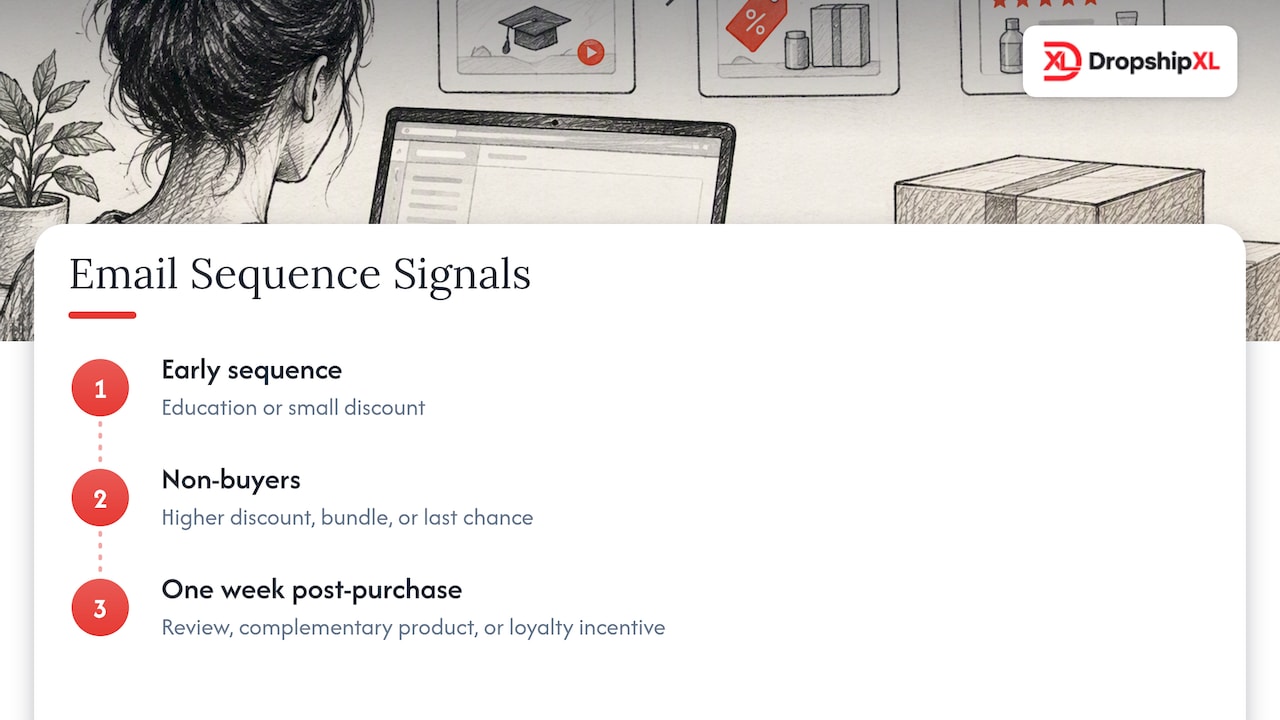
Most people sign up for a competitor’s email list, read the welcome email, and stop there. That is leaving the most useful data on the table. The real insight often shows up several emails into the sequence, where a brand’s retention strategy starts to appear.
Let your research inbox collect emails for a few weeks before drawing conclusions. Early in a sequence, brands tend to lead with education or a small discount. Further in, watch for how they handle non-buyers. Do they increase the discount, introduce a bundle, or send a straightforward “last chance” message? Post-purchase flows matter just as much. A brand asking for a review, suggesting a complementary product, or offering a loyalty incentive a week after purchase is telling you exactly how they extend customer lifetime value.
Watch timing patterns too. If a competitor consistently sends their best offer on a Friday or right before a holiday, that is not random. It is a tested cadence worth noting for your own send schedule. The deeper you go, the easier it is to see which messages are templated filler and which ones are built around real purchase data. My batch task guide covers how to turn these learnings into a repeatable weekly send routine.
What competitor content marketing tells you about their long-term bets
Ads show you what is converting today. Content, blogs, YouTube channels, and other long-form material shows you what a brand is betting on for the next year. Pull up a competitor’s blog and look at posting frequency, topic clusters, and whether content ties back to specific products.
A brand publishing buying guides around one product category is signaling that they expect sustained demand there, not just a short-term trend. The same logic applies to video. A YouTube channel with consistent unboxing or demo content around a single product line usually means they are building authority around it rather than testing and moving on.
Cross-reference content topics against the ads and keywords you have already gathered. When a product shows up in their paid ads, their organic search rankings, and their blog content all at once, that is about as strong a signal of a durable winner as you will find anywhere in this process. My successful dropshipping store examples and my lifestyle brand examples both show how winning stores align content, ads, and SEO around the same products.
How to track competitor pricing and promotions over time
Pricing tells a story if you check it often enough to see the pattern instead of a single snapshot. Visit a competitor’s core product pages weekly and log the price, any visible discount, and the framing used (percentage off, dollar amount, bundle deal, free gift).
By tracking prices over time, you will see whether their “sale” is a genuine discount or an everyday price dressed up with urgency language. Watch for patterns tied to calendar events. Many brands run near-identical promotions around the same dates each year, which gives you a predictable window to plan your own campaigns around or deliberately avoid.
Also track how pricing interacts with the ad offers you have already collected. If an ad promises a discount but the site already shows that price as the default, you have learned something important about how they frame discounts versus how they actually structure margin. My high-ticket dropshipping guide and my net terms suppliers guide both cover how margin structure drives these pricing choices.
How to watch competitor influencer and affiliate programs
Influencer and affiliate partnerships are often the least visible part of a competitor’s marketing, but they leave trails if you know where to look. Search branded hashtags and discount codes tied to specific creator names. A unique code showing up across multiple posts from the same influencer usually indicates an active affiliate relationship rather than a one-off post.
Track how often the same creators repeat promotions for a brand. A single sponsored post might just be a paid placement. A creator promoting the same product repeatedly points to a longer-term partnership and a product the brand believes in.
Pay attention to which platforms they prioritize. A brand leaning heavily into TikTok creators but barely touching YouTube is telling you where they believe their audience actually makes buying decisions, which is worth factoring into your own influencer outreach later. My affiliate marketing guide walks through building the other side of this relationship on your own store.
How to study competitor landing pages and the signals they expose
Once you have collected a handful of competitor landing pages through the ad methods above, read them side by side rather than one at a time. Look at page structure. Hero section. Social proof placement. FAQ sections. Where the add-to-cart button sits relative to the page’s persuasive copy.
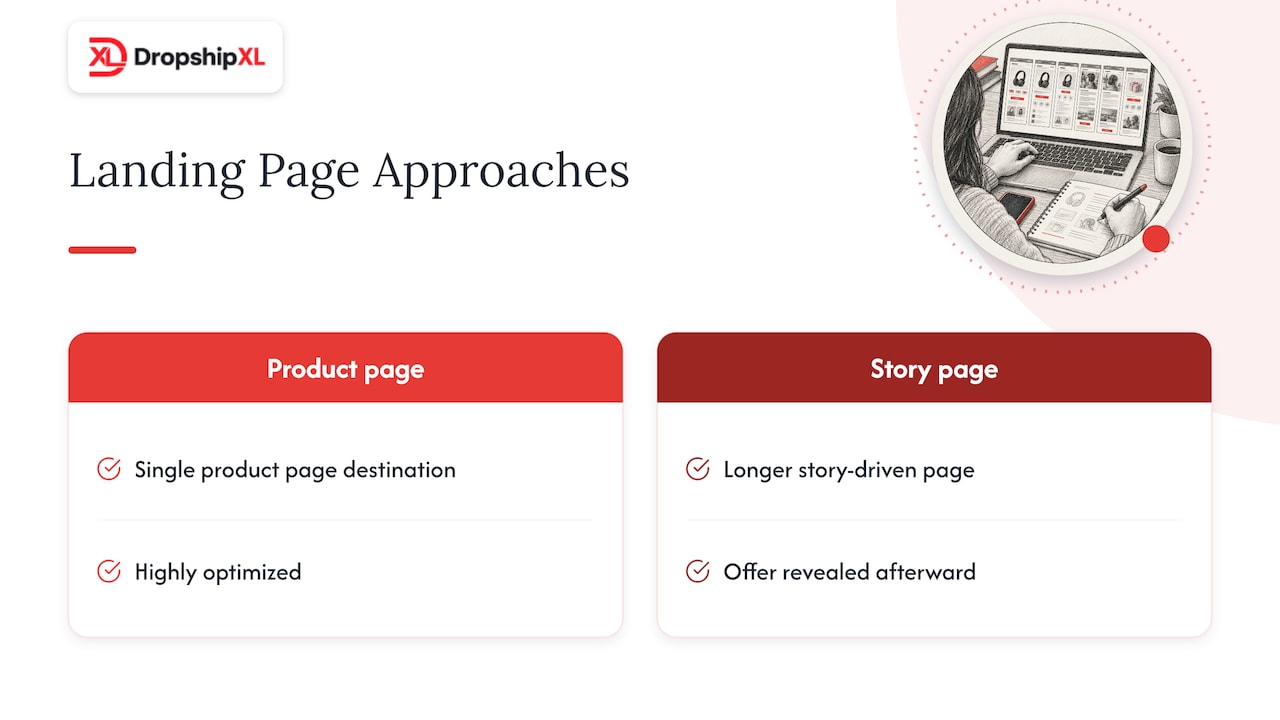
Pay attention to how many steps stand between the ad click and checkout. Some brands send traffic to a single highly-optimized product page. Others run a longer story-driven page before revealing the offer. Note which approach shows up most often for long-running ads in your niche, since that repetition likely reflects what is converting best for that audience.
If you notice a competitor running a test, like a redirect to a new landing page variant, treat that as evidence they are actively experimenting rather than settled on a final design. My one-product store guide covers the single-page approach specifically, and my store design guide covers the longer story-driven approach.
A quick experiment worth running this week
Pick a product niche and run Methods 1, 3, and 5 together. Meta Ad Library, Google Ads Transparency Center, and letting yourself get retargeted. Over the next 7 to 14 days, recurring ads, hooks, and offers will give you a short list of leads worth investigating. The goal is inspiration, not duplication. Write down what you learn. Build your own version. Test it honestly against a current best performer. My dropshipping launch checklist and my scaling strategies guide both help you turn this short list into real revenue.
How to turn your research into a launch-ready sales page
Finding a winning hook or offer is only half the job. Putting it into a sales page that is actually built to convert is where a lot of dropshippers get stuck, especially if design and copywriting are not your strongest skills. My MVP PRO Dropship Design Package is built to close that gap.

Instead of piecing together a page yourself from templates and guesswork, my team builds a complete, launch-ready sales page around the product and offer you have validated through your own competitor research, applying the same seven-step process I have used with more than 3,270 students.
- A done-for-you sales page built around your validated product and offer.
- Design structured around your product and offer, not a generic template.
- A faster path from “I found a winning ad” to “I have my own tested page live.”
If you would rather talk through how this applies to your specific product first, book a free 30-minute dropship mentoring call. My Academy Membership walks you through the full seven-step curriculum, and my DFY Focus 1 and Mentoring package is a lighter option for sellers who want a single high-converting page with direct guidance.
FAQ
Are you allowed to mention competitors in your own ads
Yes. Comparative advertising that names a competitor is legal as long as the claims are truthful and can be substantiated. Comparative ads are judged under the same standards as any other advertising claim, meaning the question is whether a claim is false or deceptive, not whether a competitor is named.
How do I analyze my competitors effectively
Start with free sources like ad libraries, Google search, and retargeting to see what competitors are actively promoting, then layer in SEO and backlink data to confirm which products carry lasting organic demand. Combine that with email and social monitoring to understand their full customer lifecycle, not just a single ad or page.
What is an efficient way to track customers and competitors at the same time
Letting yourself get naturally retargeted after browsing a competitor’s site shows you their entire customer-facing ad sequence for free, while signing up for their email list reveals the same journey through a different channel. Running both side by side gives you a fuller picture of how they move a shopper from first visit to purchase.
How do I spy on competitor ads specifically
The Meta Ad Library and the Google Ads Transparency Center are the fastest free starting points, since every active ad on those platforms is publicly searchable by advertiser name or keyword. From there, note which ads have been running longest, since sustained spend is usually the clearest sign of a profitable product or offer.

Here are 4 other ways I can help you when you're ready: