
This article walks you through finding influencers for your dropshipping store the way I teach it to the students I mentor. Start with your buyer, not a follower count.
Define who you sell to, search the platforms where they already hang out, vet every candidate on real engagement and audience data, then reach out with a personal, specific offer. For a small-budget store, that usually means small creators, free product, and clear terms.
You will leave with a 5-step outreach process, three copy-paste messages, and a budget range you can use this week.
Jim Rohn captured the whole influencer-outreach mindset in a single line.
“You are the average of the five people you spend the most time with.” — Jim Rohn
Your brand becomes the average of the creators it stands next to, so choose them on purpose. That is the exact mindset for a dropship store. Pick creators you would be happy to stand beside, treat them well, and let the long game compound. I have mentored more than 3,270 students across 17 years of ecommerce, and the stores that build real traction with influencers are not the ones chasing the biggest name. They are the ones sending 10 well-matched products to 10 small creators and watching which post produces a sale. My influencer marketing for dropshipping guide, my affiliate marketing guide, and my content marketing guide all pair with the system below.
Why small creators are the right fit for a small dropship store
Influencer marketing means paying, gifting, or otherwise partnering with people who have an audience so they feature your product. US influencer spending passed 10 billion dollars in 2025, and the biggest brands are competing for the biggest names, which is exactly why you should not.
Creators are usually grouped by size. Mega (1M+ followers), macro (100K to 1M), micro (10K to 100K), and nano (under 10K). Definitions vary a little from source to source, but the idea is the same. For a store with a small budget, nano and micro creators win for three reasons.
- Price. A creator with 8,000 followers will often accept product plus a modest fee. A creator with 800,000 will not answer a cold DM from a new store.
- Fit. Small creators tend to focus on one topic. Home espresso, dog training, van life. That is a niche audience you can match to a niche product.
- Trust. Research consistently shows higher engagement for micro-influencers despite smaller reach. Results vary by niche, so treat it as a reason to test, not a promise.
In my coaching, the stores that get traction fastest are not the ones with the best-known creator. They are the ones who send 10 well-matched products to 10 small creators and watch which post produces a sale. My successful dropshipping store examples, my lifestyle brand examples, and my branded dropshipping guide all show how stores pair small creators with a tight brand voice.
How to start with your buyer and your goal, not a follower count
Before you open a single profile, answer 4 questions. What are you trying to achieve, what are you promoting, who is the intended audience, and how will you assess success?
Translate that into plain terms for a dropship store.
- Buyer. Age range, interests, where they live, what platform they scroll, and what they already buy in your niche.
- Product. One hero product, not your whole catalog. A creator can show one thing clearly.
- Goal. Sales from a trackable link, email signups, or content you can reuse in ads. Pick one for your first round.
- Success number. Decide in advance. For example, “two sales per creator,” or “a cost per sale under my break-even.”
If you have not validated your niche yet, do that first. My niche validation steps, my dropshipping saturation guide, and my high-demand products breakdown save you from paying creators to promote a product nobody wants.
How to pick the right creators once you have your list
Why audience fit beats follower count every time
A creator’s audience should look like your buyer. A fitness creator with 50,000 followers who are mostly teenagers is a poor match for a premium kettlebell set. Even when a creator’s content looks right, their actual audience may not be. That is why you ask for data.
How to research their content, not just their numbers
Check whether the creator’s existing content fits your messages, the quality is good, the audience matches, and existing posts get positive engagement.
- Scroll their last 30 posts. Do they already feature products naturally?
- Read the comments. Are people asking “where did you get that?”
- Check how past sponsored posts performed compared to regular posts.
How to vet for fake followers and red flags before you reach out
No public number is perfect, so you are looking for enough evidence to make a decision.
- Sudden follower spikes with no viral post behind them.
- Repetitive or irrelevant comments (strings of emojis, generic praise).
- Audience concentrated in countries you do not ship to.
- Reach or views far below what the follower count suggests.
- A big gap between followers and real community activity.
Then ask for current first-party analytics. A screenshot or export of audience location, age, and recent reach from their own account. A real creator will have this ready. Also search their name plus words like “controversy” or “scam,” and scan old posts and comments for anything that would embarrass your brand next to theirs. My trust badges guide and my store design conversion guide both cover the brand-side trust elements that make the creator partnership land.
Keep a simple spreadsheet with columns for handle, platform, niche, follower count, average views, engagement notes, audience location, red flags, and outreach status. It turns a messy scroll into a shortlist you can compare.
Where to find influencers on each major platform
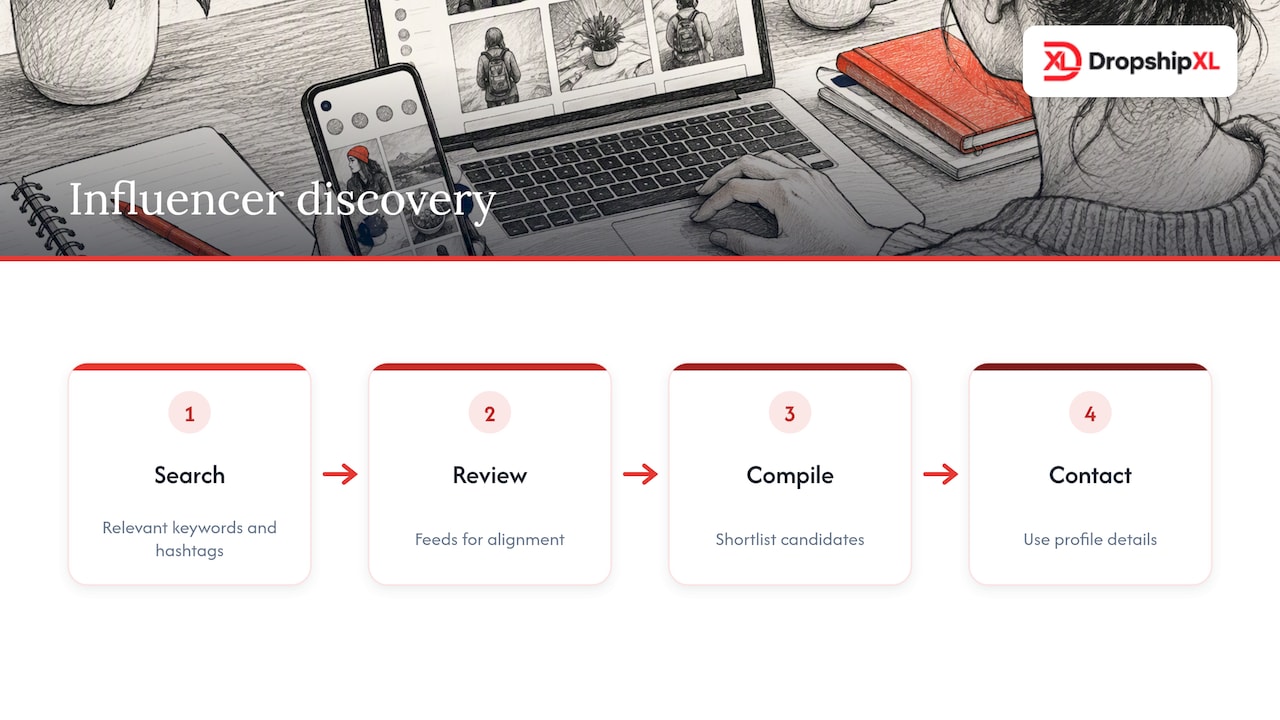
There is no single best platform. Choose based on where your buyer is, what content your product needs, your goal, and your budget. The simple rule for discovery is to search the platform with relevant keywords and hashtags, review feeds for alignment, compile candidates, and contact them through the details in their profiles.
How to find creators on TikTok
Search your product keywords plus “review,” “haul,” and “must have.” Open the videos with the most saves and comments relative to views, then check who made them. Look at the “Related” suggestions on a good creator’s profile. For a deeper playbook, read my TikTok marketing guide, my guide to going viral, and if you sell through its shop, my TikTok Shop policy guide.
How to find creators on Instagram
Search niche hashtags, then switch to “Recent” to find active small accounts rather than only the top posts. Check the Tagged tab of competing stores’ profiles to see which creators already promote products like yours. My Manus video ad guide shows what good short-form content looks like, so you know what to ask for.
How to find creators on YouTube
Search “best
” and “ review.” Mid-sized channels with 5,000 to 50,000 subscribers often reply to emails, list a business address in their About tab, and publish videos that keep selling for months.Why newsletters and communities deserve a slot in your plan
Newsletter and community platforms give brands access to highly engaged, niche audiences. For a niche product, a sponsored mention in a small newsletter can beat a social post.
Why your own customers and tagged posts are the warmest list you own
This is the most overlooked source. Anyone who already tags your store, comments on your ads, or follows you is a warm candidate. Reach out to them first. My repeat buyers breakdown and my upsells and cross-sells guide both cover how to turn one of these customers into a long-running creator relationship.
Paid discovery tools and creator marketplaces exist, and they add filters for audience age, gender, and location. Most new stores do not need them. Do the manual search for your first 20 creators, then decide.
The 5-step outreach process I give every student
Define the objective, audience, and budget before outreach, then contact candidates through their preferred public channel. Here is that turned into a routine.
- Build a shortlist of 20. Use the spreadsheet. Aim to hear back from 4 to 6 and work with 2 to 3.
- Warm them up. Follow, like, and leave 2 genuine comments over a few days. Do not overdo it. You want your name to ring a bell, not look like a bot.
- Send the first message. Use the creator’s preferred channel. If their bio lists a business email, use email. If it says “DM for collabs,” use a DM.
- Follow up once. Wait 4 to 7 days, then send a short reminder. One follow-up is professional. Three is pestering.
- Agree terms in writing and ship. Confirm deliverables, deadline, usage rights, compensation, your tracking link or code, and the disclosure requirement. Then ship fast and track results.
My batch task guide, my dropship automation guide, and my launch checklist all cover how to run this outreach routine as a weekly rhythm instead of a one-time push.
Three copy-paste outreach templates that actually get replies
Replace everything in brackets. The specific detail in the first line is what makes it read as a real message from a real person.
Template 1. The first DM to a creator you have never spoken to
Hi [Name], I loved your [specific video/post about topic], especially [one concrete detail]. I run [Store name], and we make for [type of buyer you share]. I’d love to send you one to try, no strings attached. If you like it and want to share it, we’d talk about a paid collab too. Is it okay if I ask where to ship it?
Template 2. The email for creators with a business inbox
Subject. Product for [Name]’s [niche] audience
Hi [Name],
I’m [Your name] from [Store]. I’ve been watching your [platform] content on [topic], and your [specific post] is what made me reach out.
We’d like to send you to try. If it’s a fit, here’s what we’d propose. [1 video, Reel, or post] by [date range], with your own take and creative freedom. We’d offer
and a unique link for you to share.We’d need the post to include a clear paid-partnership disclosure. If you’d like our rate sheet or have yours, I’m happy to compare.
If it’s not for you, no problem at all. Thanks for your time.
[Name, store link]
Template 3. The polite follow-up that is not pestering
Hi [Name], just floating this back up in case it got buried. We’d still love to send you . If the timing is bad or you’re not taking collabs right now, just say so and I won’t bring it up again. Either way, I’m a fan of your [topic] content.
How creators want to be pitched if you want replies
Creators put real time and creative work into content, and the pitches that get answers respect that. What consistently works with my students.
- Be specific. Mention an actual post. “Love your content” is spam.
- Say what you are offering in the first message. Free product, paid fee, commission, or a mix. Hiding compensation wastes everyone’s time.
- Keep creative freedom. Give 2 or 3 key points, not a script. Their audience trusts their voice.
- Be clear on rights. If you want to reuse the video in ads, say so and agree on it and price it.
- Pay on time and ship fast. Small creators talk to each other.
- Take no for an answer. A polite reply today can be a yes in 6 months.
Why disclosure is not optional
In the US, a connection to a brand must be disclosed clearly, prominently, and with the endorsement itself, not buried on a profile page or in a pile of hashtags. That includes free product, since gifted products can matter to how an audience views a review. Put disclosure in your agreement, and treat the one-page briefing you send every creator as part of your brand’s standard operating procedure. This is general information, not legal advice, so check with an attorney for your situation.
Mentor Tip. I have my students write a one-page creator brief that spells out the disclosure requirement, the key points, and the usage rights before any product ships. 10 minutes of writing prevents the two most common post-launch arguments. Who owns the content, and whether the disclosure was clear enough.
A simple budget for comparing gifting versus paid posts
There is no official price list for creators, and rates swing widely by niche, platform, and content type. The ranges below are rough starting points from what I see with small stores, not industry statistics. Treat them as a planning frame and negotiate.
| Approach | What you pay | Rough range per creator | Best for |
|---|---|---|---|
| Gifting only | Product cost plus shipping | Your landed cost, often $10 to $40 | Nano creators, first tests |
| Gifting plus commission | Product plus a percentage on sales via code | Product cost plus 10 to 20 percent per sale | Creators who like your product |
| Small paid post | Flat fee plus product | About $50 to $250 | Micro creators with proven engagement |
| Paid plus usage rights | Flat fee plus ad rights | Often higher than the post fee alone | Proven content you want to run as ads |
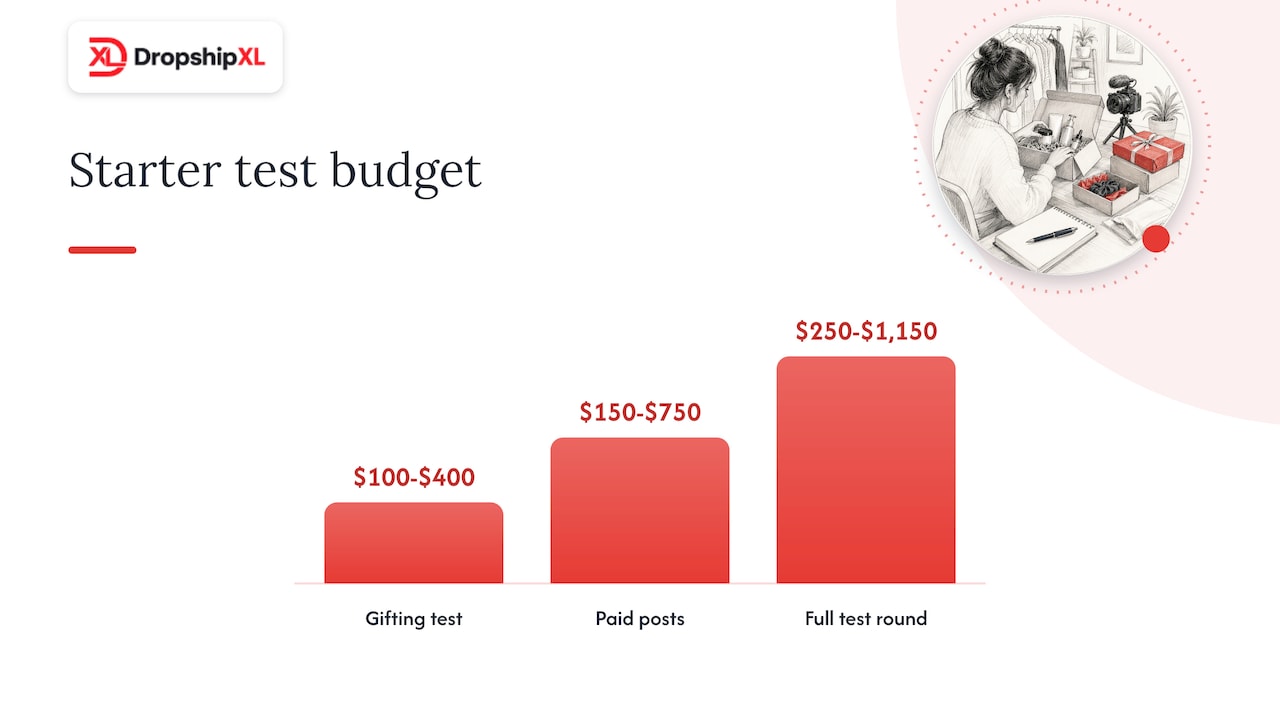
A starter test budget. 10 gifted products (about 100 to 400 dollars depending on your costs), plus 2 or 3 small paid posts (150 to 750 dollars). That is a first round you can run for roughly 250 to 1,150 dollars, and it should produce enough data to decide what to scale.
Before you pay anyone, know your numbers. If your gross profit per order is 18 dollars, a 150-dollar post must produce more than 8 orders to break even on that post alone. My dropshipping profit calculator guide, my Facebook ads break-even guide, and my ecommerce metrics guide all walk through the math.
How to measure the numbers that tell you what to scale
Set your criteria before launch and tie them to your goal. For a store, that usually means tracking.
- A unique link or discount code per creator.
- Orders, revenue, and cost per sale per creator.
- Saves, shares, and comment quality, not just views.
- Whether the content can be repurposed as an ad.
Your product page matters here too. Traffic from a creator you paid for is wasted on a weak page, so run through my product page optimization guide, my one-product store guide, and my conversion tracking guide first.
Why creators are partners in a test, not a lottery ticket
I have seen the same pattern across thousands of students. The winners treat creators as partners in a small test, not as a lottery ticket. The seven-step process I teach starts with the niche and the buyer, then supplier and store, and only then marketing, because a good creator can only amplify something that already converts. Over 17 years of building ecommerce brands, the most dependable results have come from small, relevant creators, honest terms, and fast follow-through. Start small, learn what your buyer responds to, and then scale what works. My first-sale fast guide, my scaling strategies guide, and my scaling walkthrough show the full path once your first round of creators pays off.
Mentor Tip. I have my students schedule a second round of outreach to any creator whose first post sold even one unit. The second collaboration almost always outperforms the first, because the creator already knows the product and the audience is already warm.
How DropshipXL helps you turn creator traffic into actual sales
Influencers send people to your store. Your store has to convert them. My DropshipXL Academy Membership is 997 dollars per year and walks you through my seven-step process, from niche to supplier to marketing. If you want personal guidance, book a free 30-minute dropship mentoring call, or have my team build the store with the MVP PRO Dropship Design Package.
- MVP PRO Dropship Design Package. A done-for-you store built around a validated product, 2,897 dollars one-off.
- DFY Focus 1 and Mentoring package. A lighter 697-dollar starting point for a single high-converting page with direct guidance.
- Ongoing 1-on-1 dropship mentoring. Personal guidance for sellers who want hands-on help.
Your first week of influencer outreach step by step
- Day 1. Write down your buyer, hero product, goal, and success number.
- Days 2 to 3. Build a 20-creator spreadsheet from native search, hashtags, and tagged posts.
- Day 4. Vet them for fake followers, audience location, and past controversies.
- Days 5 to 6. Send personalized DMs or emails with the templates above.
- Day 7. Follow up once, then track results.
Do this for one round, learn from the data, and repeat with the creators who sell.
FAQ
How do I find influencers with basically no budget
Start with your own customers, tagged posts, and hashtag searches, then offer free product to nano creators. Be upfront that it is a gift and ask for an honest post with a clear disclosure. Expect some to decline, and send to more people than you need.
How many followers should an influencer have for a small store
There is no magic number, but nano (under 10K) and micro (10K to 100K) creators are usually the best starting point. Engagement quality, audience location, and niche fit matter more than size.
Do I actually have to pay influencers to work with them
Not always. Some creators will post for free product, others want a flat fee or a commission. Whatever you agree, put it in writing, and make sure the post discloses the relationship.
How do I know if an influencer has fake followers
Look for sudden follower spikes, generic or repetitive comments, an audience in the wrong countries, and reach far below follower count. Then ask for their own analytics screenshots, which a genuine creator can usually provide.
Should I use a tool to find influencers right away
You can, but you do not need one at the start. Manual search takes more time and teaches you your niche. Consider a tool once you are managing dozens of creators at once.

Here are 4 other ways I can help you when you're ready: