
AI has already changed how a dropship store gets built, but not in the way most of the hype suggests.
Used well, AI shrinks product research from weeks to days, automates the repetitive order and tracking work that used to swallow your evenings, and lets you test ad creative at a pace one person could never match alone.
Used poorly, AI picks a bad product, trusts a shaky supplier, and ships a store full of generic ads that look exactly like everyone else’s.
This article walks you through where AI actually helps, where human verification still has to carry the weight, and the sequence my students follow to turn these tools into a repeatable business instead of a pile of disconnected software.
Reid Hoffman has a line that fits this moment exactly.
“If you are not embarrassed by the first version of your product, you’ve launched too late.” — Reid Hoffman
That is the right spirit for AI dropship. Use the tools to launch a small, tested version of your idea quickly, then let real data from real buyers tell you what to fix and what to scale. The sellers I have mentored into real income are the ones who ship fast, verify every supplier by hand, and let AI do the heavy lifting on volume while they handle the judgment calls.
How AI-powered product discovery actually works for dropshippers
AI product research tools scan ad libraries, social trend signals, and marketplace velocity data to surface items that are gaining traction before they go mainstream. The real skill is not finding products. It is filtering them fast enough to act while the window is still open.
A working pipeline looks like this. Pull daily signals from ad libraries and trending hashtags. Score each candidate against margin potential and search momentum. Move only the top scorers into a validation stage. The sellers I have watched do this well set a high threshold before they commit a single ad dollar, which keeps budget away from fads that burn out inside a week.
Here is a simple scoring framework you can start with today.
- Trend velocity. Is search or social interest climbing week over week, or has it gone flat?
- Margin potential. Does the landed cost leave real room for a profitable price point once ad spend is included?
- Supply depth. Are multiple suppliers carrying it, or is it a single-source risk you cannot replace quickly?
- Saturation level. How many other stores are already running ads on it, and how fresh does your angle still feel?
Once a product clears that screen, validate it cheaply before you build out a full store. Run a basic landing page with a single ad set. Order a sample for yourself. Watch for real engagement rather than vanity metrics like likes. My product research tools breakdown walks through the specific tools that handle this scoring work without making you build spreadsheets from scratch, and my niche validation steps cover the cheap tests that come before any ad spend. If you are still weighing whether this market has room for a new store, my dropshipping saturation guide and my high-demand product breakdown give the honest read.
Mentor Tip. I have my students order the physical sample before they commit any ad budget. Photos and listings rarely tell you how an item actually feels in hand, and that difference is what shows up in your reviews once orders start rolling in.
How to find and vet suppliers with AI support that holds up
AI tools can surface supplier shortlists fast, but they cannot replace the verification work that protects your margins and your reputation. The right way to use AI here is as a scout that narrows your options, with you as the person who signs off on the deal.
AI-assisted supplier tools do real work. They flag shipping time patterns, spot review anomalies, and catch inconsistencies in product photos across multiple listings. That narrows your options quickly. What AI cannot do is confirm whether a supplier will actually hit the delivery window they advertise once you start sending them real order volume.
Before you commit to a supplier, work through this sequence.
- Place a personal sample order and time the actual delivery against the quoted window.
- Request lead time documentation in writing, not just a chat message, so you have something to reference when timelines slip.
- Review the contractual terms for return handling, defect replacement, and minimum order expectations.
- Cross-check reviews on at least two independent platforms rather than trusting the supplier’s own storefront ratings.
Once you have verified real shipping speed, translate that straight into your product page promises. If a supplier consistently ships in 7 to 10 days, say exactly that instead of a vague “fast shipping” claim. Mismatched promises are where refund disputes start. My supplier vetting checklist, my inventory management tools guide, and my guide to finding suppliers that actually deliver cover how to keep supplier data synced and reliable once you have locked in a source worth scaling behind. My supplier role breakdown and my faster-shipping guide both go deeper on the shipping-window conversations I have my students run before every launch, and sellers sourcing in the US can also get a strong starting shortlist from Watchman Advisors’ USA supplier directory.
Mentor Tip. I have my students treat every new supplier as a trial relationship for the first 30 days. Track actual ship times against promises before you scale ad spend behind them, because a supplier who slips at low volume will slip harder at high volume.
How to automate store operations without losing control
Store automation works best when AI handles volume and humans handle exceptions. The goal is not a hands-off store. The goal is a store where your attention goes to the handful of orders that actually need it.
Good candidates for automation include order routing to the correct supplier, tracking number updates pushed to customers, and inventory flags that alert you when a SKU is running low or a supplier goes out of stock. These are high-volume, low-judgment tasks where AI genuinely saves hours every week.
A practical automated workflow looks like this.
- Order placed triggers automatic routing to the assigned supplier based on your product feed.
- Tracking sync pulls carrier updates and emails customers without any manual input.
- Inventory flag alerts you the moment a supplier’s stock drops below your set threshold.
- Human checkpoint reviews any order flagged for delayed shipping, damaged goods, or a refund request before it is processed.
That last step matters. Refunds, disputes, and anything touching a customer’s money should pass through a real person, never a fully automated rule. Watch three KPIs weekly to know whether the system is holding up. On-time shipping rate, refund rate, and chargeback rate. A jump in any of them usually points to a supplier problem before it shows up anywhere else. My dropship automation guide and my guide to using AI to design a dropship store show how these pieces fit together from setup through daily operation. For the fulfillment side specifically, see my dropship order fulfillment walkthrough, my chargebacks guide, and my batch task guide for the daily routines that keep the human checkpoint sane as volume grows.
How to use AI for ad creative without sounding like every other store
AI speeds up creative production, which also creates a sameness problem when every store runs the same AI-generated hook over the same trending sound. The dropshippers who win with AI ads treat the tool as a first draft machine. The finished product still needs a human pass.
A workflow that holds up over time. Generate several creative variations with AI. Run them as small tests. Have a human polish the winner before you scale real spend behind it. That human pass is what keeps your ads from blending into a feed full of identical AI content.
- Generate multiple hook variations and headline permutations quickly with AI tools.
- Test each variation on a small budget before you commit any real spend.
- Polish the top performer with a human edit for tone, pacing, and brand voice.
- Scale only the version that has already proven itself in a small test.
Short video hooks, headline permutations, and thumbnail variants are where AI tools add the most speed, since you need dozens of options to find the one or two that click. My Manus video ad guide walks through a 5 to 10 minute workflow for this exact step. Match the creative work to the channel you are testing. My Facebook ads for dropshipping guide, my Google Ads vs Facebook Ads breakdown, my TikTok marketing guide, my influencer marketing guide, and my dropshipping SEO guide each cover the channel-specific angles AI tools cannot read from a blank prompt.
Mentor Tip. I have my students budget micro-tests at a fixed small spend per variation and judge the first round by cost per click before they ever look at total conversions. That one habit saves more money per month than any single ad-platform setting.
How to stay compliant while using AI inside your store
AI speeds up your store, but the legal responsibilities around shipping and reviews have not changed, and they still land on you, not the software. A few rules matter more than the rest.
Shipping promises are the first one. Ship within the time you advertise, or within a reasonable period if you have not stated one. If a shipment is delayed, notify the buyer and let them choose between waiting or canceling for a full refund. The second rule is about reviews. Do not buy, sell, or publish fake or false reviews, including AI-generated ones you knew or should have known were false. Both of these line up with how the FTC enforces online retail already.
Run through this checklist before you launch.
- Match your stated shipping times to what your supplier actually delivers.
- Send a clear delay notice the moment a shipment misses its window.
- Never purchase, fabricate, or publish AI-generated reviews.
- Have a human verify any AI-written product claim before it goes live on your store.
Treat every AI-written product description or customer response as a draft, not a final answer. Generative models can produce confident-sounding claims that are not accurate, especially around shipping times or product performance, and those claims are what trigger refund disputes and policy flags. My dropshipping legality guide, my returns address walkthrough, my ecommerce fraud prevention guide, and my trust badges breakdown each cover a slice of compliance most sellers only learn about after their first problem.
How DropshipXL turns AI tools into a repeatable system
Tools alone do not build a business. A structured process does, and that is the part AI software cannot provide on its own.
I use a seven-step process to guide my students through building and scaling their stores. AI fits into several of those steps directly. Product discovery in the research phase. Automated order routing once the store is live. Ad variation testing during the scaling phase. The mentoring layer is what connects those AI-assisted moves into a sequence you can repeat every time you launch a new product or test a new niche.
What my students actually gain from working through this with me.
- A structured seven-step curriculum covering niche selection through scaling.
- Verified supplier guidance that cuts out the guesswork AI alone cannot resolve.
- Done-for-you store design options for a faster, tested launch.
- One-on-one mentoring checkpoints that catch mistakes before they cost you money.
My guide to starting a dropshipping business in 2026, my print-on-demand breakdown, my dropshipping business plan guide, and my launch checklist all expand on how AI assistance fits inside the seven-step sequence. For sellers who want to aim higher per transaction, my high-ticket dropshipping guide covers the economics that make the math easier even before AI enters the picture.
What a realistic AI-assisted launch timeline looks like
Most aspiring dropshippers underestimate how much the early research phase shrinks with AI, and overestimate how fast scaling happens after that.
Week one is product research and validation. Running AI-assisted discovery, scoring candidates, and ordering samples. Weeks two and three cover supplier verification and store setup, including the human checks on shipping times and contract terms covered above. By week four, most of my students who follow the sequence are live with a tested product page and an initial small-budget ad test running through the generate-test-polish-scale workflow.
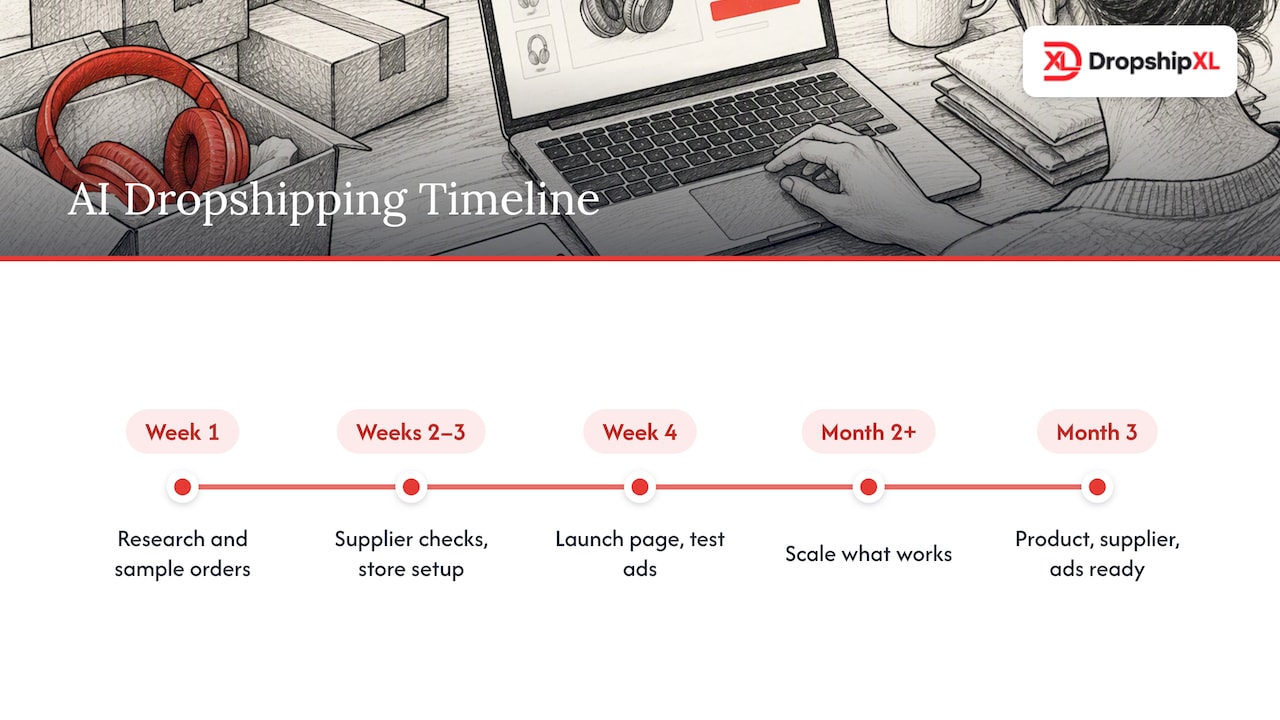
The scaling phase from month two onward is where AI’s time savings add up. Automated order routing and tracking sync free up hours that used to go into manual fulfillment, and that time shifts toward testing new ad variations and expanding into adjacent products. Students who treat month one as pure validation, instead of rushing to scale an unproven product, almost always avoid the costly mistake of pouring ad spend behind something that was never going to convert.
By month three, a store built this way usually has a validated hero product, a verified supplier relationship with documented lead times, and a small library of tested ad creatives ready to scale further. The pace varies by how much time you can put in weekly, but the sequence stays the same regardless of speed. Research. Verify. Launch small. Scale what works. My first-sale fast guide walks through the mental shift sellers need to make inside those first 30 days, and my scaling strategies guide and my scaling walkthrough both cover what comes after month three.
What it actually costs to start and scale with AI tools
AI software lowers the time cost of starting a dropship store, but it does not eliminate the real money you need for ads, samples, and store infrastructure.
Expect to spend on a handful of categories early on. AI research and automation tool subscriptions. Sample orders from your shortlisted suppliers. A small ad budget to run your first round of micro-tests. None of these are optional if you want data instead of guesses. Skipping the sample order to save a little money is how sellers end up shipping a product they have never actually touched.
As you scale, costs shift rather than simply growing. Ad spend climbs behind proven winners, but tool costs often stay flat since most AI research and automation platforms price per seat rather than per product tested. The bigger scaling cost tends to be creative production, since a growing ad account needs a steady stream of new variations to prevent audience fatigue. My dropshipping profit calculator guide and my conversion tracking guide are worth bookmarking before you touch a credit card, so the numbers behind every tool and ad decision stay honest.
If you would rather skip the trial-and-error phase of figuring out store setup, a done-for-you build removes that cost variable entirely. The MVP PRO Dropship Design Package is priced as a one-time 2,897 dollar fee, with smaller DFY builds available for stores that need a lighter starting point. Budgeting for both tools and a tested launch structure upfront almost always costs less in the long run than rebuilding a poorly planned store later.
How to choose the right AI tools for a dropship business
Not every AI tool marketed to dropshippers earns a place in your workflow, and the selection criteria matter more than the feature list.
Start with data transparency. A tool that shows you why it is recommending a product, which signals it is weighing, is far more useful than a black box that just spits out a score. If you cannot see the reasoning, you cannot catch the tool’s mistakes before they cost you ad spend.
Next, check integration depth. A product research tool that does not connect cleanly to your order routing or inventory system creates manual work you were trying to avoid in the first place. The best AI tools in a dropship stack talk to each other, not just to you.
Finally, weigh any AI-recommended supplier against the same manual verification steps you would use for a supplier you found yourself. Sample orders. Documented lead times. Independent reviews. A tool that bypasses those steps entirely is cutting a corner you should not let it cut.
Price matters less than fit here. A cheaper tool that integrates well and shows its reasoning will save you more time than an expensive one that does neither.
Common problems when adding AI to a dropship workflow
Most AI integration headaches are not about the software failing. They are about sellers trusting an output they never checked.
The most common issue is treating AI product scores as a final verdict instead of a first filter. A high trend score does not account for supplier reliability or your own margin math after ad costs. Skipping the manual validation step is where a lot of promising products quietly fail.
A second frequent problem is automation that runs too far without a human checkpoint. Order routing is safe to automate. Refund decisions and customer disputes are not. Sellers who automate those too aggressively often end up with angry customers and chargebacks that could have been caught with a five-minute manual review.
Creative sameness is the third common snag. When every store runs AI-generated hooks pulled from the same trending templates, ad fatigue sets in fast and conversion rates drop across the board. The fix is the generate-test-polish-scale workflow above. Let AI handle volume. Let a human handle the final polish.
Last, generative AI models produce confident-sounding product claims that are not always accurate. Any AI-written product description or customer response needs a human read-through before it reaches a buyer, especially around shipping times or product performance claims.
Why the set-it-and-forget-it AI pitch does not hold up
The loudest claims about AI dropship promise a business that runs itself. That promise is what gets people to buy a course or a tool subscription, and it is also what gets people stuck when their first few products flop and they have no idea why.
Here is what AI dropship actually supports. AI is excellent at narrowing a thousand options down to twenty, and at handling repetitive tasks once a product is proven. AI is not good at supplier judgment, brand voice, or deciding what a customer dispute deserves. Most conventional advice skips that distinction, selling automation as a replacement for decision-making rather than a tool that speeds it up.
If you are starting out, build the verification habits before the automation habits. A fast product shortlist means nothing if you never order the sample. A beautifully automated store means nothing if your supplier cannot actually hit the shipping window you promised. Build the judgment first, then let AI handle the volume.
Get hands-on help applying AI the right way inside your store
Reading about AI dropship workflows is one thing. Having someone experienced check your product picks, your supplier contracts, and your store setup before you spend real ad money is a different level of safety entirely.
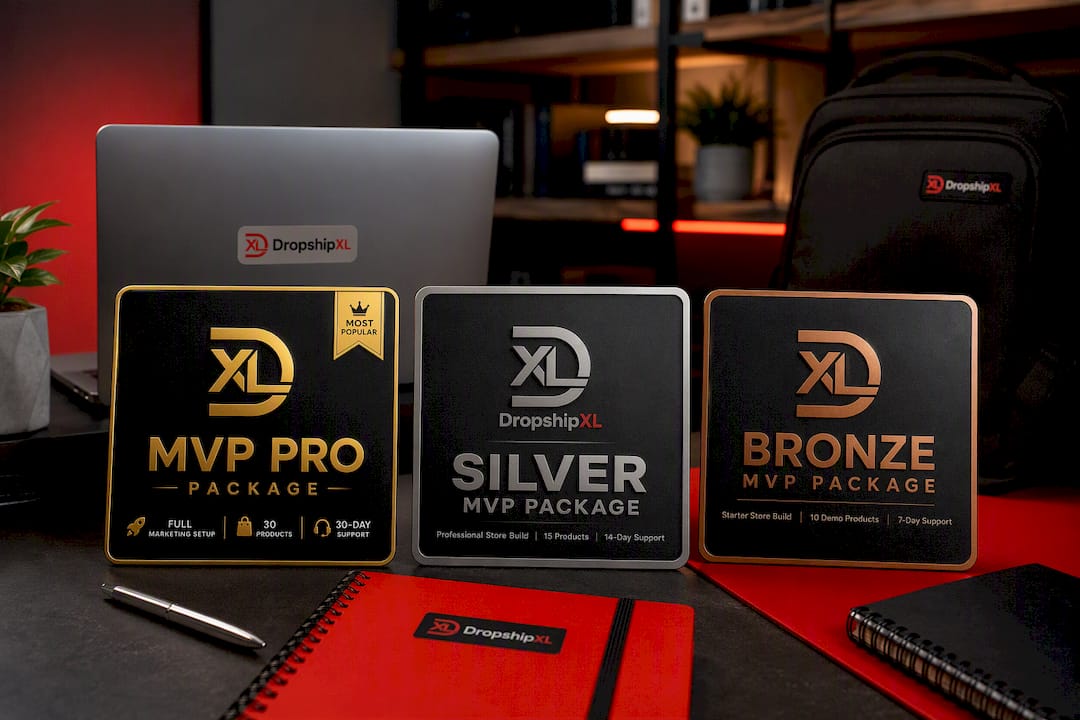
That gap is what my mentoring closes. The DropshipXL Academy Membership gives you the full seven-step curriculum and ongoing access to my guidance for 997 dollars per year, so every AI-assisted product pick and supplier choice gets a second set of experienced eyes before you commit budget to it.
If you would rather skip the build phase entirely, my MVP PRO Dropship Design Package delivers a fully built, done-for-you store for a one-time 2,897 dollar fee, so you launch with a tested structure instead of guessing your way through setup. For a lighter entry point, my DFY Focus 1 and Mentoring package starts at 697 dollars. Prefer to talk through your specific situation first? Book a free 30-minute dropship mentoring call and we can map the best next move together before you spend a dollar.
FAQ
Is AI dropship a real working approach
Yes. AI dropship is a real method where tools handle product research, order automation, and ad creative testing while human verification of suppliers and claims still carries the weight. The tools speed up research and operations. They do not replace judgment on supplier reliability or compliance with shipping and review rules.
How do I realistically make 10,000 a month with AI-assisted dropshipping
Reaching that level typically requires a validated product with real margin, a reliable supplier with documented lead times, and a tested ad creative system that has already proven itself in small-budget tests before scaling. It usually takes multiple product tests and several months of disciplined validation rather than one lucky launch, which is why a repeatable process matters more than any single tool.
How much do AI dropshippers actually earn
Earnings vary widely depending on product selection, ad spend discipline, and how rigorously suppliers are verified before scaling. No single figure represents a typical outcome. Sellers who skip sample orders and automate too aggressively tend to see refund and chargeback problems eat into margin faster than revenue grows.
Is AI dropshipping still profitable with more competition in 2026
AI dropshipping remains viable, though tools that simply surface trending products create more competition since many sellers see the same signals at the same time. The dropshippers who stay profitable combine AI-assisted discovery with manual supplier verification and a distinctive, human-polished ad creative approach instead of relying on AI output alone.
What legal rules apply to AI-generated content in a dropship store
Fake or false reviews are prohibited, including AI-generated ones a business knew or should have known were inaccurate. Shipping claims must also match what your supplier actually delivers, with a clear delay notice and a refund option offered to any buyer whose order misses the advertised window.

Here are 4 other ways I can help you when you're ready: