
What if you could sell fully customized products to customers across the country without ever touching a single item of inventory?
That’s exactly what a POD dropship business makes possible. Print-on-demand dropshipping is a fulfillment model where products are printed and shipped directly to your customer only after they place an order. No warehouse. No bulk buying. No unsold stock sitting in your garage. Platforms like Printful, Printify, and Prodigi connect your online store to print facilities that handle production, packaging, and shipping automatically.
Here’s what makes this model worth your serious attention.
- Zero inventory risk. You pay for production only when a sale happens.
- Full product customization. Your designs, your brand, your packaging.
- Low startup costs. Most POD platforms are free to join.
- Fast production. Over 80% of custom products are ready to ship within 24 to 48 hours.
- Domestic shipping speed. Standard US delivery typically runs 3 to 5 business days.
- Scalable from day one. Add new products without adding overhead.
POD dropshipping fits entrepreneurs who want brand control, product uniqueness, and a low-risk entry into ecommerce. If you’ve been wondering whether this model is right for you, keep reading. Every section below gives you a clearer picture of how it works, what it costs, and how to build it into something real.
- POD vs. Traditional Dropshipping
- The Real Pros and Cons
- How Profitable This Actually Is
- Strategies That Actually Work
- Frequently Asked Questions

POD vs. Traditional Dropshipping
Both models let you sell without holding inventory, but the mechanics and business outcomes are meaningfully different. Understanding those differences upfront saves you from choosing the wrong path.
In traditional dropshipping, you sell products that a third-party supplier already manufactures and stocks. You list their items, collect orders, and the supplier ships. The products are generic, meaning dozens of other sellers list the exact same item. Competing on price becomes almost unavoidable.
POD flips that dynamic. Every item is produced after the sale, printed with your custom design. That means your products are unique to your brand. A customer searching for your design can only find it in your store.
A few things worth calling out from that comparison.
- Branding control is where POD wins decisively. White-label packaging means your customer never sees the print provider’s name.
- Margins in POD depend heavily on your pricing strategy and niche. Apparel margins tend to be tighter; non-apparel categories like tech accessories and home decor often deliver better returns.
- Operational complexity is slightly higher in POD because you need quality design assets. A generic mockup rarely converts as well as a real product photo.
If you want to understand my dropshipping business model at a deeper level before committing to POD, that foundation will help you make a smarter decision.
The Real Pros and Cons
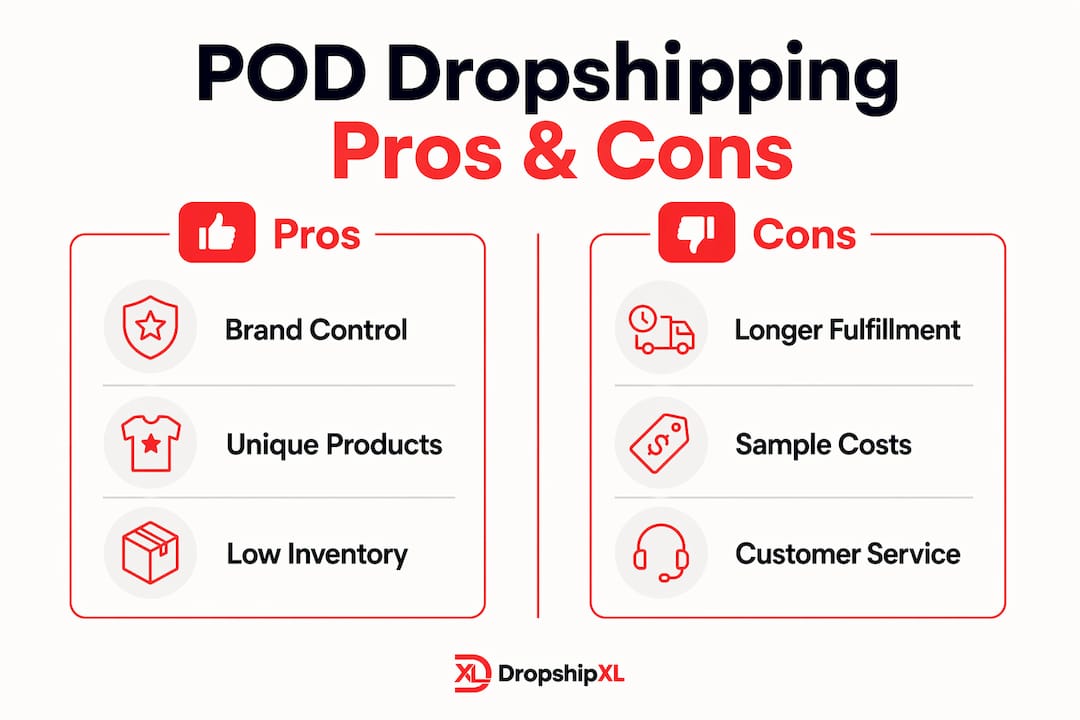
POD is genuinely exciting as a business model, but it’s not perfect for everyone. Here’s an honest look at both sides.
The advantages are real.
- No upfront inventory investment means you can test dozens of designs with zero financial risk.
- Full customization lets you build a brand that customers actually remember and return to.
- You can run the business from anywhere with a laptop and an internet connection.
- Adding new products takes minutes, not weeks of supplier negotiation.
- Printify’s catalog alone features over 1,300 customizable products, so your options are wide.
The challenges you need to plan for.
- Production time adds to total delivery time. A 2 to 3 day print window plus 3 to 5 day shipping means customers may wait longer than they expect.
- Print quality varies by provider. A design that looks sharp on screen can disappoint on fabric if you haven’t ordered samples.
- Customer service falls on you, even when the print provider makes the mistake. Your brand takes the hit.
- Margins can be tight on lower-priced items, especially in saturated apparel categories.
- Printful’s 99.76% order approval rate shows what a top-tier provider can deliver, but not every provider operates at that standard.
Common pitfalls and how to avoid them.
The biggest mistake new POD sellers make is skipping physical samples. You cannot accurately judge color accuracy, print quality, or product feel from a digital mockup. Order samples before you launch. It costs a small amount upfront and saves you from a wave of refund requests later.
Customer service is the other area people underestimate. When a package arrives late or a print looks off, your customer contacts you, not the print provider. Build a clear response process before your first sale, not after your tenth complaint.
Mentor Tip: Order samples of your top five products before going live. Real product photos convert far better than mockups, and you’ll catch quality issues before your customers do.
How Profitable This Actually Is
Profitability in POD dropshipping comes down to three things: your niche, your pricing, and your marketing. None of those are fixed. All of them are learnable.
The scale potential is documented. Printful has handled over 139 million orders, which tells you the demand for custom products is not a niche curiosity. It’s a mainstream consumer behavior. The question is whether your store captures a slice of it.
Margins vary by product category. Apparel is the most competitive and often the thinnest. Non-apparel categories like tech accessories, home decor, and custom stationery tend to carry higher perceived value and lower return rates. Beginners who go straight to T-shirts often wonder why margins feel so tight. The answer is usually category selection, not the model itself. My dropshipping business plan guide covers how to think through category and pricing decisions like this before you commit.
What actually drives profit in a POD business.
- Niche specificity. A store selling custom dog breed phone cases outperforms a generic “custom products” store almost every time. Tight niches attract buyers with higher purchase intent. My product research tools guide covers how to narrow that down before you design a single product.
- Pricing discipline. Factor in production cost, shipping, platform fees, and ad spend before you set a price. Underpricing is the fastest way to work hard for nothing.
- Repeat buyers. A customer who loved their first order is far cheaper to sell to again than acquiring a new one. Repeat buyers drive a disproportionate share of long-term revenue, which I cover in my guide to building a full-time dropshipping income.
- Order routing. Using print partners closest to your customers cuts shipping time and cost. That directly affects your margins and your reviews.
- Marketing validation. Test designs with small ad budgets before scaling spend. Kill what doesn’t convert. Double down on what does.
Scaling a POD operation also means planning for peak periods. Production lead times plus shipping times can stack up during holidays. Sellers who account for that in their customer communications avoid the negative feedback that tanks store ratings. Using automated order routing across multiple print facilities is how serious POD businesses handle volume without sacrificing delivery speed.
Statistic to know: Printful has fulfilled over 139 million orders as of 2026, confirming that the print-on-demand market operates at genuine commercial scale, not just hobbyist volume.
Strategies That Actually Work
I’ve personally mentored over 3,270 students through a systematic 7-step process for building and scaling dropshipping businesses. That experience across thousands of real student journeys reveals patterns that separate stores that grow from stores that stall. Here’s what that experience points to for POD specifically.
Niche and supplier selection.
- Choose a niche with a passionate, identifiable audience. Pet owners, hobby communities, and sports fans are examples of groups that buy custom merchandise repeatedly.
- Vet your print provider the same way you’d vet any supplier. Check fulfillment speed, print quality reviews, and their return policy before you commit. My guide on the role suppliers play in your store’s success covers this same vetting process.
- Prodigi routes orders to the print facility closest to your customer automatically, which is a meaningful operational advantage for US-based sellers with international buyers, and it’s the same reason I point students toward vetted USA dropshipping suppliers for domestic orders specifically.
Platform integration and automation.
- Connect your store to your print provider through a direct integration so orders route automatically. Manual order processing does not scale.
- Use order routing tools to split production across multiple print partners when volume grows. This protects you from a single provider’s downtime affecting your entire business.
- Track fulfillment status from your dashboard so you can catch delays before customers notice them.
Branding and customer experience.
- White-label packaging is non-negotiable if you want customers to associate the experience with your brand, not a generic shipping box. Most major POD platforms offer this.
- Invest in real product photography. Customers who receive a product that matches what they saw in your store photos leave better reviews and come back.
- Build your customer service process before you launch. A clear, fast response to a fulfillment issue turns a potential one-star review into a loyal customer.
Marketing validation before scaling.
- Run small paid ad tests on your top designs before committing to a full campaign. Let the data tell you what the market wants.
- Use multi-channel marketing to reach customers across platforms rather than depending on a single traffic source.
- Email marketing to past buyers is one of the highest-ROI channels available to POD sellers. Build that list from day one.
The sellers who succeed in POD are not the ones with the most products. They’re the ones who picked a specific audience, built a brand that audience trusts, and then scaled what was already working. Niche down first. Scale second.
Understanding how order fulfillment actually works at a mechanical level also helps you communicate realistic timelines to customers and avoid the mismatched expectations that generate complaints.
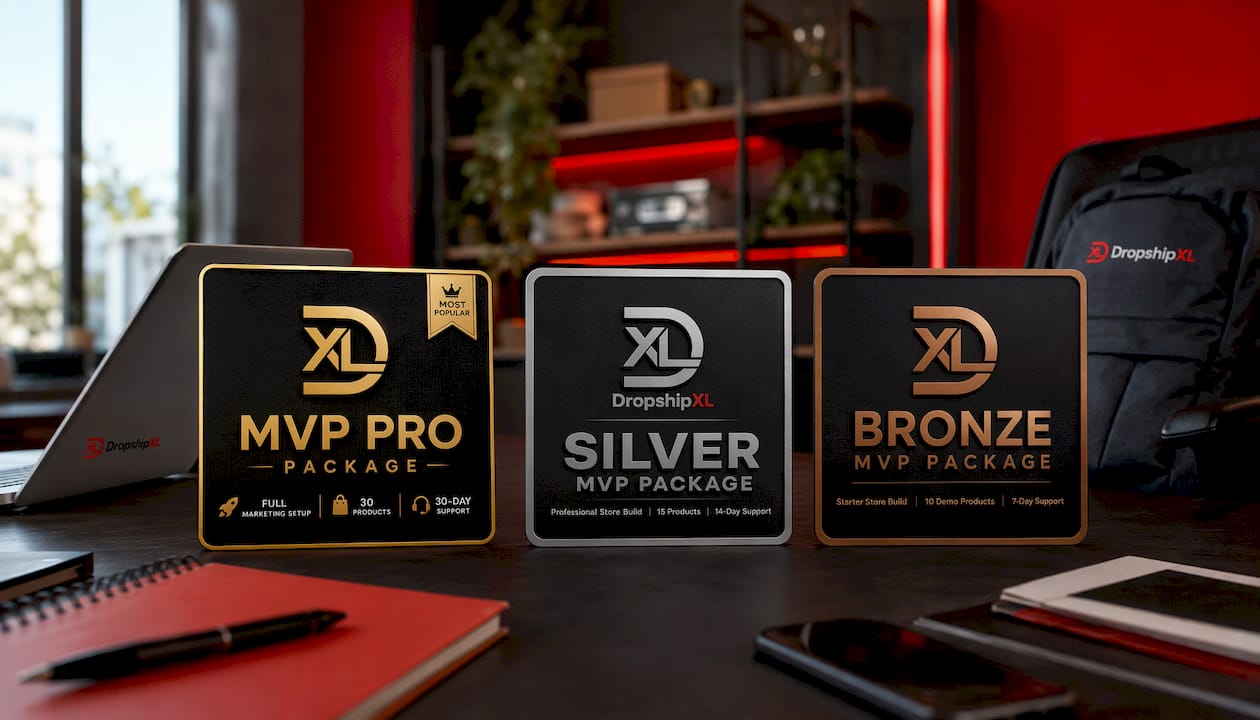
If you’re ready to build your POD brand with professional design assets from the start, my MVP PRO Dropship Design Package gives you a done-for-you foundation so you’re not starting from a blank page.
If you’d rather talk through your specific niche and POD strategy directly, book a Free 30-minute dropship mentoring call, or go ahead and join the DropshipXL Academy if you already know you’re ready to build.
Frequently Asked Questions
What Is POD in Dropshipping?
POD stands for print-on-demand. In dropshipping, it means products are printed and shipped to the customer only after an order is placed, with no inventory held by the seller. Platforms like Printful, Printify, and Prodigi handle the production and shipping automatically once your store sends them the order.
Is POD Better Than Traditional Dropshipping?
POD offers stronger branding control and product uniqueness, while traditional dropshipping is simpler to start with no design work required. Which is better depends on whether you want to build a recognizable brand around custom products or move existing, pre-manufactured products quickly with less setup.
Can You Make Serious Money With a POD Dropship Business?
Yes, but margins depend on niche selection, pricing strategy, and marketing efficiency, not on the model alone. Non-apparel categories like tech accessories and home decor tend to deliver better margins than saturated apparel niches, and repeat buyers matter more to long-term profit than any single winning design.
What Does a POD Dropship Business Cost to Start?
Most POD platforms are free to join with no minimum order requirements, so your real upfront cost is design work and a small testing ad budget. Ordering physical samples of your top products before launch adds a small cost but prevents far more expensive refund requests later.
Which Print-on-Demand Platform Should I Use?
Printful, Printify, and Prodigi are the most established options, each with different strengths: Printful is known for fulfillment reliability, Printify for its wide product catalog, and Prodigi for automatically routing orders to the print facility closest to the customer. Order a sample from any provider before committing to it.
How Do I Start a POD Dropship Business?
Choose a niche, select a print provider like Printful, Printify, or Prodigi, create your designs, connect your store through a direct integration, and launch with a small marketing test before scaling your ad spend. Order physical samples of your top designs before you go live.

Here are 4 other ways I can help you when you're ready: