
What if the thing you do on weekends for fun is actually your most defensible business asset?
That question is worth sitting with. Because right now, hobby niches are scaling businesses faster than most traditional retail categories. Product categories outside the top 100 now account for a majority of all sales on major ecommerce platforms, and they are growing faster than mainstream categories. The data is clear: specificity wins.
Here is how hobby niches scale into real businesses in practice.
- Validate first. Confirm real demand before spending a dollar on inventory or setup.
- Own a micro-niche. Serve 10,000 to 50,000 passionate buyers before expanding outward.
- Build community. Loyalty and word-of-mouth grow faster in tight-knit hobby circles than in mass markets.
- Source specialized suppliers. Niche-specific suppliers deliver better product quality and faster shipping than general marketplaces.
- Monetize incrementally. Add revenue streams only after your core niche is profitable.
- Use AI to your advantage. AI-attributed purchases skew heavily toward specialized products, with a large majority of those orders coming from long-tail categories.
The entrepreneurs winning right now are not chasing broad audiences. They are going deep on one specific thing that a specific group of people genuinely needs.
- Hobby Niches Worth Building a Business Around
- Start and Scale It Step by Step
- Strategies That Keep It Growing
- My Honest Take on Scaling a Hobby
- A Proven Path to Scale Yours
- Frequently Asked Questions
Hobby Niches Worth Building a Business Around
The most profitable hobby businesses share one trait: they serve customers who feel underserved by mainstream options and are willing to pay a premium for something built specifically for them. Here are categories with proven traction, and I cover the same kind of scoring approach in my guide to validating a hobby dropshipping niche.
- Urban beekeeping supplies. One entrepreneur built a $2.3 million annual revenue business selling specialized urban beekeeping equipment, averaging $186 per order with 38% profit margins. That is a stark contrast to mainstream pet supply sellers averaging $31 orders and 8% margins.
- Adaptive clothing. Wheelchair-accessible apparel is a category mainstream retailers consistently overlook. One micro-niche operator reached notable annual revenue with strong profit margins by focusing entirely on this underserved community.
- Sports trading cards. From 2021 to 2025, Shopify stores selling trading cards grew more than sixfold, turning a hobbyist corner of commerce into a $500 million-plus industry.
- Left-handed kitchen tools. A textbook micro-niche: a specific pain point, a passionate community, and almost zero mainstream competition.
- Eco-friendly pet products for apartment dwellers. Hyper-specific, repeat-purchase, and growing alongside urban pet ownership trends.
- Handmade and specialty jewelry. Unique craftsmanship commands premiums that mass-produced alternatives cannot match, and wholesale channels can multiply revenue without requiring a bigger production footprint.
- Homebrewing supplies and education. Hobbyists who brew award-winning beer can sell kits, recipes, and online courses to a community that actively seeks expertise.
- Specialty photography niches. Wedding, product, and stock photography each represent distinct sub-markets with different monetization paths.
- Botanical and small-batch soap. Standardized recipes and premium packaging can turn a weekend craft into a repeatable product line with strong margins.
- Collectible miniatures and tabletop gaming. A deeply passionate community with high average order values and strong repeat purchase behavior.
Mentor Tip: The best niche is not the one with the most Google searches. It is the one where buyers feel like no one has built exactly what they need. That gap is your opportunity.
Start and Scale It Step by Step
The difference between a hobby that earns a little side income and one that becomes a real business usually comes down to process. Here is the sequence that works.
- Identify your micro-niche. Get specific. “Outdoor gear” is not a niche. “Ultralight backpacking gear for solo female hikers” is. The tighter your focus, the lower your customer acquisition cost and the higher your margins. Profitable niche selection starts with finding a group of people who feel underserved.
- Validate demand before spending. Interview 5 to 10 potential buyers. Review competitors. Check whether people are actively searching for and buying similar products. Pre-sell or run a small pilot batch before committing to inventory. Skipping this step is the single most common reason hobby businesses fail early. I walk through this exact process in my steps to validate a profitable dropshipping niche.
- Research your market and competition. Use Google Keyword Planner and Reddit community analysis to gauge search volume and buyer intent. Look for active online communities and forums around your hobby. That engagement signals a market willing to spend.
- Build your business model. Decide whether you will sell physical products, digital products, services, or a combination. For most hobby entrepreneurs, dropshipping hobby products removes the inventory risk while letting you test demand with minimal upfront cost.
- Source specialized suppliers. 73% of successful micro-niche stores work directly with niche-specific suppliers rather than general marketplaces. My guide on the role suppliers play in your store’s success covers how to vet these relationships, and vetted USA dropshipping suppliers are often a stronger starting pool for hobby niches than an overseas catalog, since niche buyers notice shipping speed and packaging quality more than most.
- Set up your ecommerce presence. Build your own online store so you control your brand, customer data, and margins. Test one sales channel first before expanding.
- Price for profit, not just competitiveness. Micro-niche stores average notably higher order values compared to broad-category stores. You can charge more when you serve a specific community with exactly what they need.
- Launch with a focused marketing push. Start with organic social media in the communities where your buyers already spend time. Email marketing builds a direct relationship that no algorithm can take away, and it drives repeat purchases and long-term loyalty at a fraction of paid ad costs.
- Reinvest profits before expanding. Bootstrap your growth by putting early profits back into better product sourcing, improved packaging, or targeted ads. Avoid expanding into adjacent niches until your core niche is consistently profitable.
- Master your core niche before branching out. Successful niche scaling requires establishing a strong base before adding adjacent categories. Expanding too early dilutes your brand and raises acquisition costs.
- Plan your operations for scale. Ask yourself when you will need inventory management software instead of spreadsheets, and when demand will outpace your available hours. Build those systems before you need them, not after, the same forward-planning I cover in my dropshipping business plan guide.
Strategies That Keep It Growing
Getting to your first sales is one challenge. Building a business that compounds over time is a different one entirely. These strategies are what separate hobby businesses that plateau from ones that keep growing.
Build community before you need it. The most durable hobby businesses are built on genuine community trust. Monetization that deepens engagement and shared curiosity sustains growth; monetization that feels extractive kills it. Show up in forums, Facebook groups, and subreddits as a contributor, not just a seller.
Use AI matchmaking to your advantage. AI-powered discovery now connects hyper-specific products to precisely interested buyers at scale. The more specific your product, the better AI gets at making the match. A search engine rewards popularity; an AI agent recommends relevance. That shift heavily favors niche market growth over mass-market plays.
Diversify revenue without losing focus. Once your core product line is profitable, add complementary revenue streams.
- Digital products (patterns, guides, templates) that complement physical goods
- Online courses or workshops for buyers who want to learn the skill
- Subscription tiers with early access to limited product runs
- Affiliate partnerships with complementary niche brands
Collect and act on customer feedback. Niche buyers are vocal and specific. Their feedback tells you exactly what to build next. One adaptive clothing entrepreneur expanded from shirts into pants, outerwear, and accessories for the same customer base, growing customer lifetime value from $186 to $394 in the process.
Specialize your marketing channels. Broad-category sellers burn money on generic paid ads. Niche businesses win with targeted content: YouTube tutorials, Instagram reels, TikTok demonstrations, and email sequences built around the specific interest, the same approach I break down in my guide to content marketing for dropshipping. Micro-niche stores have significantly lower customer acquisition costs compared to broad-category stores, largely because their marketing speaks directly to a defined audience.

Maintain niche focus while expanding. The temptation to chase adjacent markets too early is real. High specialization builds pricing power and discourages large generalist competitors who lack the specific knowledge to compete. Own your niche completely before you expand.
My Honest Take on Scaling a Hobby
There is a pattern I have seen repeatedly with the 3,270-plus students I have mentored through DropshipXL. The ones who struggle are almost always trying to sell everything to everyone. The ones who build real income pick one specific thing, go deep on it, and resist the urge to expand until the numbers actually justify it.
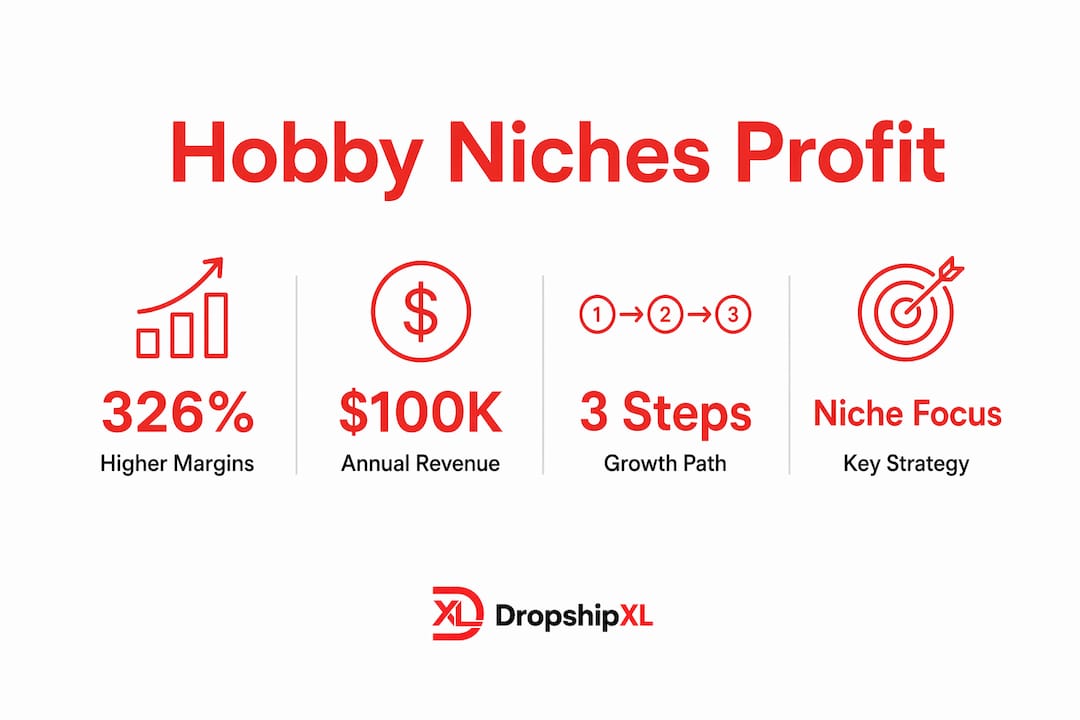
The data backs this up. Micro-niche stores achieve 326% higher profit margins than broad-category sellers. That is not a marginal advantage. It is a structural one, built on lower acquisition costs, higher order values, and customers who come back because you understand their specific needs better than anyone else.
What most people underestimate is how much the community piece matters. When you genuinely participate in the hobby you are selling into, buyers can tell. That authenticity is not just feel-good advice. It is what drives repeat purchases, word-of-mouth referrals, and the kind of brand loyalty that makes your business resilient when competitors show up. Monetizing a hobby does not have to mean losing the joy of it. The best hobby entrepreneurs I have worked with treat their business as an extension of their passion, not a replacement for it.
The other thing worth saying plainly: most people wait too long to start because they want everything to be perfect. Validate your niche, find a reliable supplier, set up a clean store, and get your first sale. Everything else you can figure out as you go. The steps to validate your niche are not complicated. What is hard is actually doing them instead of planning indefinitely.
A Proven Path to Scale Yours
Knowing the strategy is one thing. Having a mentor walk you through it, step by step, is what actually moves the needle.
My structured 7-step mentoring program covers exactly what hobby entrepreneurs need: niche selection, supplier sourcing, store setup, marketing validation, and scaling. I’ve personally guided over 3,270 students through this same process I use to run my own 6- to 7-figure ecommerce business.

If you are ready to stop guessing and start building, my MVP PRO Dropship Design Package gives you a done-for-you store built around your niche, so you can focus on growing the business instead of wrestling with setup. Or, if you want personalized guidance on your specific hobby niche, book a Free 30-minute dropship mentoring call and get a clear plan tailored to where you are right now. The niche you are passionate about is worth building. I can show you exactly how.
Frequently Asked Questions
What Is the 3-Year Hobby Rule for Taxes?
The IRS generally considers an activity a business rather than a hobby if it generates a profit in at least 3 of 5 consecutive years. Meeting this threshold affects how you can deduct expenses and report income, so it is worth discussing with a tax professional once your hobby starts generating consistent sales.
Can a Hobby Really Be a Niche Business?
Yes. A hobby becomes a niche business when it serves a specific, underserved group of buyers willing to pay for specialized products or expertise. Trading cards, urban beekeeping, and adaptive clothing are all examples of hobbies that scaled into multi-million-dollar niche businesses using the same validation process.
How Much Is a Business Worth That Makes $100,000 a Year?
Business valuation depends on industry, profit margins, and growth rate, but a common rule of thumb for small ecommerce businesses is a multiple of 2 to 4 times annual net profit. A niche business with strong repeat customers and low acquisition costs typically commands a higher multiple than a broad-category store.
What Are the Most Profitable Hobby Business Niches?
The most profitable niches combine specific customer pain points, high average product prices, active online communities, and limited mainstream competition. Urban beekeeping supplies, adaptive clothing, specialty trading cards, and left-handed tools are all documented examples with strong margins and repeat purchase rates.
How Do Hobby Niche Businesses Scale Without Losing Their Focus?
The proven approach is to master your core niche completely before expanding into adjacent categories. Premature expansion dilutes your brand and raises customer acquisition costs. Scale depth first, meaning more products and revenue streams for the same buyer, then breadth into an adjacent audience.
What Is the Biggest Mistake People Make Turning a Hobby Into a Business?
The most common mistake is trying to sell to everyone instead of committing to one specific, underserved group of buyers. Broad positioning forces a new hobby business to compete on price against established players, while a tight micro-niche of 10,000 to 50,000 passionate buyers builds pricing power and loyalty much faster.

Here are 4 other ways I can help you when you're ready: