
Have you ever stopped to wonder why some online stores ship orders within 24 hours while others leave customers waiting two weeks, even when both stores sell the exact same product?
The answer almost always comes down to how their supply chains are built. An ecommerce supply chain is the end-to-end system that moves a product from a supplier’s warehouse to a customer’s front door, covering every step in between: procurement, inventory management, order processing, shipping, and returns. Get it right, and your business runs like clockwork. Get it wrong, and you’re constantly putting out fires.
Supply chain management is the planning and coordination of everything involved in sourcing, procurement, conversion, and logistics. For ecommerce, that expands to include every digital touchpoint, every sales channel, and every carrier relationship you manage.
- How the Whole System Actually Works
- The Components That Make It Work
- Why This Pays for Itself
- Strategies That Actually Support Growth
- What Separates Good From Great
- Where This Is All Heading
- The Lesson Most Entrepreneurs Learn Too Late
- Build Yours on a Proven System
- Frequently Asked Questions
How the Whole System Actually Works
At its core, an ecommerce supply chain is a coordinated flow of products, information, and money moving from suppliers to customers. Unlike traditional retail, where supply chains often follow a predictable linear path, ecommerce supply chains operate across multiple channels simultaneously, from your own website to marketplaces to social storefronts, all feeding into the same fulfillment system.
The modern approach replaces isolated, siloed operations with a unified, end-to-end model where every stage communicates in real time. When a customer places an order, the system immediately checks inventory levels, routes the order to the best fulfillment location, triggers a shipping label, and updates the customer with tracking details, all without manual intervention. That level of coordination is what separates high-performing ecommerce businesses from those constantly scrambling.
Here’s how the core flow breaks down.
- Demand forecasting: Predict what customers will buy and when, so you can stock accordingly.
- Procurement: Source products from suppliers and manufacturers based on forecasted demand.
- Inventory management: Track stock levels across all locations in real time to prevent overselling and stockouts.
- Order processing: Capture, validate, and route each order to the right fulfillment point.
- Warehousing: Store products efficiently and pick, pack, and prepare them for shipment.
- Shipping and last-mile delivery: Move orders from the warehouse to the customer’s door via carriers.
- Returns and reverse logistics: Process returned items quickly to recover value and maintain customer trust.
- Customer communication: Keep buyers informed at every stage from confirmation to delivery.
The shift toward unified systems replacing fragmented tools is one of the most important developments in ecommerce supply chain management right now. My 23-point dropship store checklist covers how to set your platform up around this unified approach from the start instead of bolting it on later.
The Components That Make It Work
Understanding how ecommerce supply chains operate means knowing what each component actually does and why it matters to your bottom line.

Inventory management is the foundation. Without accurate, real-time stock data, every other part of the chain breaks down. You need to know exactly how many units you have, where they are, and how fast they’re moving. Systems that sync inventory across all sales channels prevent the costly mistake of selling products you don’t actually have.
Order management is where the coordination happens. An Order Management System, or OMS, acts as the control tower for your entire operation, routing orders, triggering fulfillment, and syncing inventory across channels with sub-5-second API updates to prevent overselling. Without a solid OMS, multichannel selling becomes a manual nightmare.
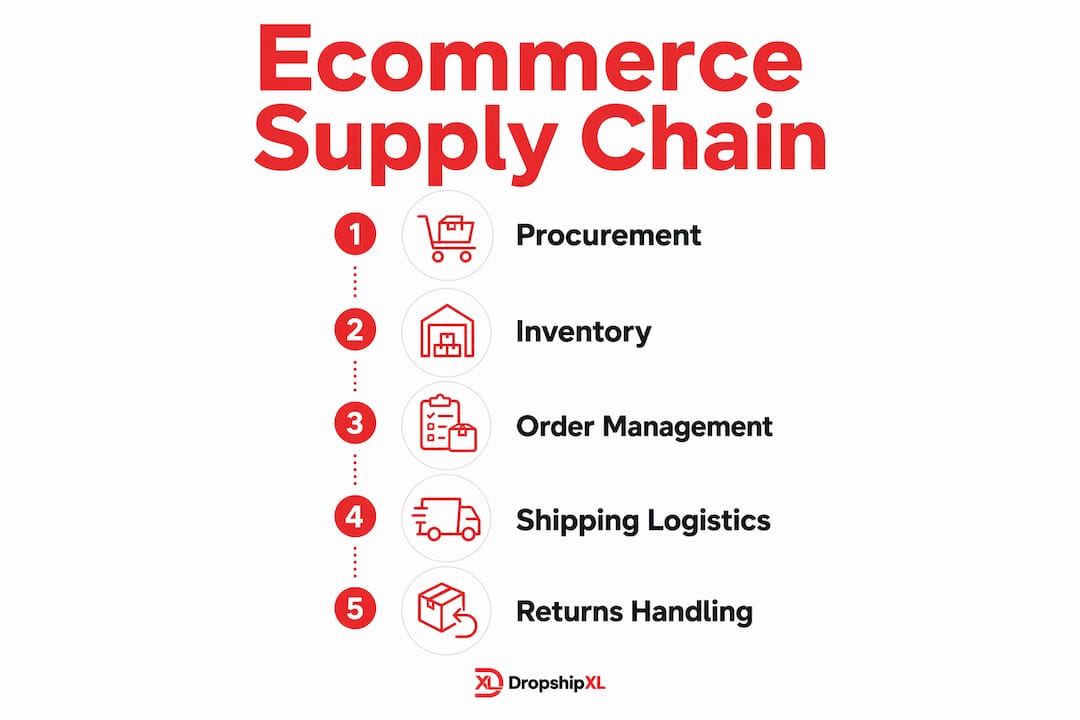
Shipping logistics covers carrier selection, rate shopping, label generation, and last-mile delivery coordination. This is often where customer experience is won or lost. A customer who gets their package two days early becomes a repeat buyer. One who waits without updates rarely comes back.
Here’s a quick breakdown of the key components and their primary functions.
Procurement and supplier relationships determine whether you have the right products at the right time. Strong supplier coordination means integrating demand signals directly with supplier production schedules, so you’re not constantly reacting to stockouts. My guide on the role suppliers play in your store’s success goes into this in more depth, and it’s exactly why I point students toward vetted USA dropshipping suppliers who can actually hold up their end of that data-sharing relationship.
Returns and reverse logistics are often the most overlooked component. Ecommerce return rates are significantly higher than traditional retail, with rates typically ranging from 20% to 30%. This means you need a dedicated process for handling returns from day one, which I cover in my refund policy guide for dropshipping.
Why This Pays for Itself
Tightening up your supply chain isn’t just an operational exercise. It directly affects your profitability and how customers feel about buying from you.
The benefits compound quickly once you move from a fragmented setup to an integrated one.
- Lower operating costs: Eliminating redundant processes, excess inventory, and manual data entry cuts overhead faster than almost any other operational change.
- Better customer experience: Real-time order updates and accurate delivery estimates reduce “where is my order?” support tickets and build trust.
- Accurate inventory counts: A unified data layer means your stock numbers are reliable, so you stop overselling and stop tying up cash in products that aren’t moving.
- Faster demand response: When your supply chain feeds real sales data back into your forecasting engine, you can reorder proactively instead of reactively.
- Fewer fulfillment errors: Automated routing rules reduce the human error that causes wrong items, wrong addresses, and missed shipments.
- Stronger supplier relationships: Sharing demand forecasts with suppliers lets them plan production more accurately, which often translates to better pricing and priority treatment for your orders.
In my experience, the majority of growing ecommerce businesses now run some kind of digital dashboard just to keep end-to-end visibility into their supply chain. That shift reflects how seriously businesses now treat supply chain transparency as a competitive advantage, not just an internal tool.
Strategies That Actually Support Growth
Most supply chain advice focuses on theory. Here’s what actually works when you’re building or scaling an ecommerce operation.
The biggest mistake entrepreneurs make is treating supply chain management as just shipping or inventory tracking. It’s a comprehensive integration of supply and demand management across your entire business and your partners. Once you see it that way, your strategy changes completely.
Proven strategies worth implementing now.
- Centralize order management first. Before adding more sales channels or warehouses, get a single OMS in place. It becomes the control tower that makes everything else manageable.
- Automate inventory sync across channels. Real-time API syncing under five seconds is the standard for preventing inventory drift in multichannel ecommerce. Anything slower creates overselling risk.
- Build supplier relationships around data, not just orders. Share your demand forecasts with key suppliers so they can align production. This reduces lead times and gives you leverage when supply gets tight.
- Use data-driven order routing. Set up rules that automatically route each order to the closest or most cost-effective fulfillment location, rather than defaulting to a single warehouse for everything.
- Design your returns process before you need it. Reverse logistics with ecommerce return rates in the 20 to 30% range can’t be an afterthought. Build a clear returns workflow from the start.
- Plan for disruption. Every supply chain faces unexpected delays, whether from supplier issues, carrier bottlenecks, or demand spikes. Contingency planning means having backup suppliers identified and alternative carriers ready before a crisis hits.
- Integrate content and marketing with supply chain data. When your marketing team knows your available-to-promise inventory, they stop promoting products that are about to go out of stock. Aligning content planning with supply chain data prevents a common and costly disconnect.
Mentor Tip: Set up automated low-stock alerts tied to your reorder points before you scale your ad spend. Driving traffic to a product you can’t fulfill is one of the fastest ways to burn your ad budget and damage customer trust simultaneously.
What Separates Good From Great
The gap between an average ecommerce supply chain and a great one usually comes down to one thing: whether you’re working from a single source of truth or stitching together disconnected tools.

A unified supply chain operates from a shared data layer where inventory, orders, and fulfillment decisions all live in the same ecosystem. When your point-of-sale system updates inventory, that change reflects instantly in your warehouse system without a separate sync step. That’s the standard worth building toward.
The OMS vs. WMS distinction matters here. An OMS controls cross-channel, multi-warehouse order logic. A Warehouse Management System handles physical floor operations inside a single warehouse. They serve different functions, and confusing the two leads to gaps in your operation. Your OMS is the brain; your WMS is the hands.
Orchestration rules take this further. Instead of routing every order the same way, automated rules evaluate shipping costs, local stock levels, and delivery speed to choose the most efficient fulfillment path for each individual order. Split-shipment logic, for example, can calculate whether it’s cheaper to ship two items from a local store and one from a distribution center, or wait and ship all three together.
Technology is accelerating all of this.
- AI and predictive analytics improve demand forecasting by analyzing historical sales data, seasonal patterns, and external signals to generate dynamic reorder points.
- IoT sensors in warehouses provide real-time location and condition data for inventory, reducing shrinkage and improving pick accuracy.
- Blockchain creates an immutable record of transactions across the supply chain, improving transparency with suppliers and carriers and reducing disputes.
- Automated customer communication triggers personalized notifications for delays, partial shipments, and delivery confirmations, cutting support volume without adding staff.
Handling returns well at this level means treating reverse logistics as a dedicated fulfillment process, not a manual exception. Returns feed real-time data back into your inventory counts and forecasting engine, closing the loop on the entire supply chain cycle.
Mentor Tip: Treat your OMS as the first technology investment in your supply chain, not the last. Entrepreneurs who bolt on an OMS after they’ve already scaled to multiple channels spend far more time and money on the migration than those who set it up early.
Where This Is All Heading
The direction ecommerce supply chains are heading is clear: more automation, more intelligence, and higher customer expectations across the board.
Fully unified, AI-driven systems are becoming the baseline for competitive ecommerce operations, not a premium feature reserved for enterprise brands. Smaller businesses now have access to tools that provide the same real-time orchestration capabilities that large retailers built custom systems to achieve just a few years ago.
Sustainability is moving from a marketing talking point to an operational requirement. Orchestration rules increasingly factor in carbon footprint alongside cost and speed, and customers are paying attention to how brands handle packaging and shipping emissions. Businesses that build sustainability into their fulfillment logic now will have a structural advantage as regulations tighten.
Multi-node inventory allocation is replacing the single-warehouse model for any business selling at scale. Distributing inventory across multiple fulfillment points, closer to where customers actually live, cuts last-mile delivery costs and speeds up delivery times. Pair that with real-time orchestration, and you can make and keep delivery promises that were impossible with a centralized model.
Customer expectations for speed and transparency keep rising. Two-day delivery is now the baseline in many categories, and proactive communication about delays has shifted from a nice gesture to a basic expectation. Supply chains that can’t surface real-time status updates to customers will lose ground to those that can. Agile risk management, with backup suppliers and carrier redundancy built in, is what keeps operations running when the inevitable disruptions hit.
The Lesson Most Entrepreneurs Learn Too Late
Most entrepreneurs I’ve worked with through DropshipXL come in thinking supply chain management is a back-office concern they’ll deal with once they’re making money. That thinking costs them more than almost any other mistake they make.
The businesses that scale dropshipping to full-time income consistently share one trait: they treat their supply chain as a strategic asset from day one, not a problem to solve later. They set up centralized order management before they need it. They build supplier relationships around shared data, not just purchase orders. They design their returns process before their first return arrives.
The entrepreneurs who struggle are usually running fragmented tools: one system for inventory, another for orders, a spreadsheet for supplier contacts, and manual processes for returns. That setup works at low volume. It collapses under growth, and the collapse always happens at the worst possible time, during a product launch or a peak season.
What I’ve seen work, consistently, is the discipline to build integrated systems early and the willingness to treat supplier relationships as genuine partnerships. A supplier who trusts you with your demand forecasts will prioritize your orders when supply gets tight. That relationship is worth more than any software you can buy.
The other thing most guides won’t tell you: your supply chain is only as good as your data. A unified data layer isn’t about expensive software. It’s about making sure every part of your operation reads from the same numbers. When your marketing team, your fulfillment team, and your suppliers all work from the same inventory reality, decisions get faster and mistakes get rarer.
Build Yours on a Proven System
Building a supply chain from scratch is hard enough. Building one without a guide who’s already done it is harder. My mentoring program walks you through a structured 7-step process, the same process I used to build and scale my own ecommerce brand to six and seven figures.

Over 3,270 students have gone through my program, covering niche selection, supplier sourcing, platform setup, marketing validation, and business scaling. The mentoring is built around avoiding the exact mistakes that sink most new ecommerce businesses, including fragmented supply chains, weak supplier relationships, and no returns process.
If you’re serious about building a real ecommerce business on a solid foundation, my dropshipping business model guide is the right place to start. You can also find reliable suppliers using the same sourcing framework I teach inside the program, covered in my guide to suppliers offering net terms, or book a Free 30-minute dropship mentoring call to talk through your specific setup.
Frequently Asked Questions
What Is an Ecommerce Supply Chain?
An ecommerce supply chain is the end-to-end system that moves products from suppliers to customers, covering procurement, inventory management, order processing, shipping, and returns. It includes the planning and coordination of all sourcing, procurement, conversion, and logistics activities, plus every digital touchpoint and carrier relationship a modern online store depends on.
What Does an Order Management System Do in Ecommerce?
An OMS acts as the central control tower for your ecommerce operation, routing orders, syncing inventory across all sales channels, and automating fulfillment decisions in real time. It differs from a Warehouse Management System, which handles only the physical operations inside a single warehouse rather than cross-channel order logic.
Why Are Ecommerce Return Rates So High?
Ecommerce return rates are significantly higher than traditional retail, typically ranging from 20% to 30%, largely because customers can’t physically inspect products before buying. Building a dedicated reverse logistics process from the start, rather than treating returns as an afterthought, is the most effective way to protect your margins as volume grows.
How Does Demand Forecasting Improve Supply Chain Efficiency?
Demand forecasting uses historical sales data, seasonal trends, and real-time signals to predict future orders, so you can reorder inventory proactively rather than reactively. Accurate forecasts reduce both stockouts and excess inventory, which directly lowers your carrying costs and keeps cash from sitting in products that aren’t moving.
What Is the Difference Between an OMS and a WMS?
An OMS is the brain: it controls cross-channel, multi-warehouse order logic and decides where each order should be fulfilled from. A WMS is the hands: it manages the physical floor operations inside one specific warehouse, like picking, packing, and shelf location. Confusing the two is a common source of operational gaps.
How Can Dropshippers Build a Reliable Supply Chain?
Dropshippers build reliable supply chains by centralizing order management, automating inventory sync across channels, and developing strong supplier relationships built on shared demand data rather than one-off purchase orders. My 7-step mentoring program covers each of these areas with a proven framework used by over 3,270 students.

Here are 4 other ways I can help you when you're ready: