
What if the biggest mistake you could make as a new entrepreneur is trying to sell to everyone?
A business niche is defined as a specialized segment of a broader market, shaped by distinct customer needs, preferences, or demographics. Serving that segment lets you tailor your products and messaging so precisely that customers feel you built your business specifically for them. That feeling drives loyalty, premium pricing, and faster brand growth. The concept is also called “niche marketing” or “market segmentation” in formal business literature, and both terms describe the same core idea: go narrow to win big.
I’ve guided over 3,270 students through this exact principle, and niche selection is the first critical step in my proven 7-step process for building 6 to 7 figure ecommerce brands.
- What a Business Niche Actually Is
- The Four Types of Niches
- Why Going Narrow Wins
- Find Your Niche in 8 Steps
- Validate Before You Commit
- What I’ve Learned Picking Niches
- How I Help You Find Yours
- Frequently Asked Questions
What a Business Niche Actually Is
A business niche is a focused market segment defined by a specific group of customers who share common needs that the mass market ignores or underserves. Think of it this way: the fitness industry is a broad market, but “resistance training equipment for women over 50” is a niche. The narrower group has specific pain points, specific budgets, and specific buying triggers that a general sporting goods store never addresses well.

The difference between a niche market and a business niche is subtle but worth knowing. A niche market is the group of people you target. A business niche is the strategic position your company occupies to serve that group. You define your business niche by combining your product category, your audience profile, and the specific problem you solve better than anyone else.
Niche businesses charge premium prices because their solutions fit complex customer needs that generic providers cannot match. That pricing power is one of the most underrated advantages of going niche. You compete on fit, not on price.
The Four Types of Niches
Niches fall into four broad categories. Each one uses a different lens to define the target customer.
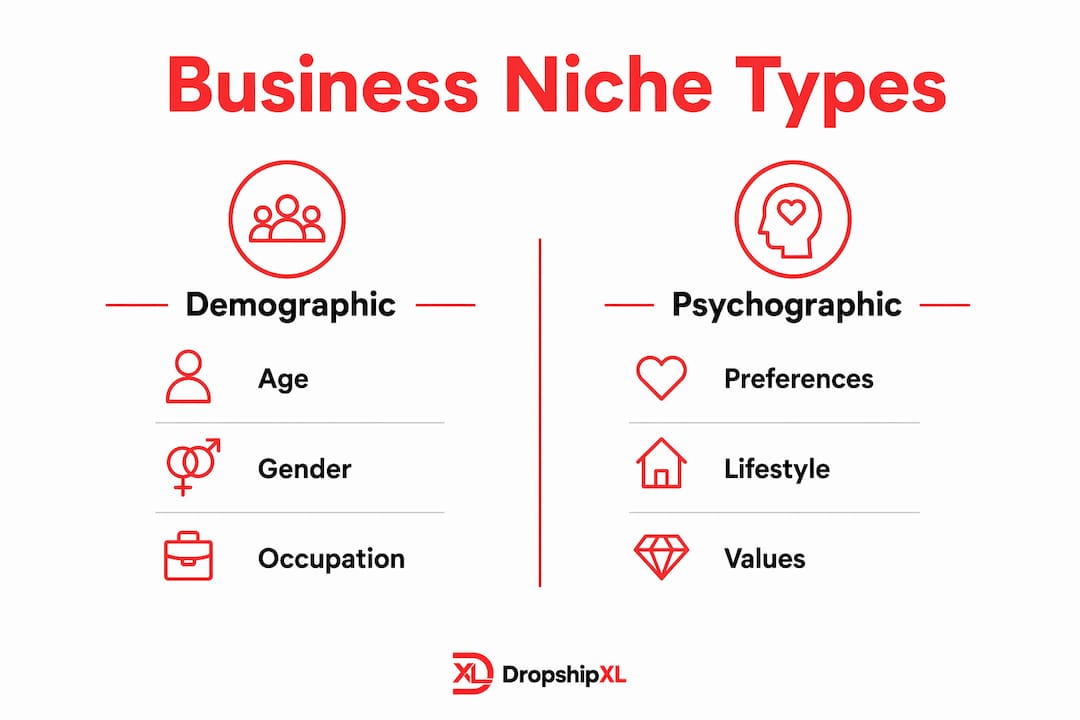
Most successful niche businesses combine two or more of these types. A profitable dropshipping niche often layers a demographic filter on top of a product category. For example, “ergonomic office chairs for remote-working parents” combines a product type, a demographic, and a psychographic lifestyle signal. I walk through this exact layering approach in my dropshipping business plan guide.
Here is what each type gives you.
- Demographic niches make targeting on paid ad platforms straightforward because platforms like Meta and Google let you filter by age, income, and job title.
- Geographic niches reduce shipping complexity and let you speak to local culture and climate in your messaging.
- Psychographic niches build the deepest loyalty because customers feel you share their values, not just their product preferences.
- Product-based niches are the easiest to validate quickly because demand data is concrete and searchable.
Choosing the right niche type depends on where your skills and market knowledge are strongest. A niche that fits your existing knowledge base is one you can serve with genuine authority.
Why Going Narrow Wins
Niche focus builds a strong brand fast and generates high customer loyalty because every product, message, and experience speaks directly to one type of person. That specificity is what separates forgettable stores from brands customers recommend to friends.
The business case for going niche is clear across several dimensions.
- Higher profit margins. Specialized offerings meet complex needs, so customers pay more without comparing you to the cheapest alternative.
- Better marketing efficiency. Targeted promotional efforts reach a well-defined audience, which lowers your cost per acquisition and raises conversion rates.
- Faster credibility. A niche brand becomes the go-to expert in its space far faster than a generalist brand ever could.
- Stronger customer retention. When customers feel understood, they come back. Repeat buyers cost far less to retain than new buyers cost to acquire.
- Reduced competition. Large corporations rarely serve small, specific segments profitably. That gap is your opportunity, and it’s exactly what my product research tools guide helps you find before a bigger player does.
Niche marketing requires a mindset shift: prioritize deep engagement with a core audience over broad brand recognition. New entrepreneurs often resist this because going narrow feels risky. The reality is the opposite. Broad positioning is what kills most new businesses because it forces you to compete on price against established players with far more resources.
Mentor Tip: Balance passion with profitability. Your niche should address a pain point in a market where customers already spend money. Passion alone does not pay the bills, but passion combined with proven demand is a powerful foundation.
Find Your Niche in 8 Steps
Finding a viable niche is a structured process, not a guessing game. Viable niches are discovered by balancing personal interest with proven market demand. Passion alone is not enough for sustained business success, but it does give you the stamina to push through the hard early months.
Use this 8-step framework to identify your niche.
- Audit your skills and experience. List what you know well, what problems you have solved personally, and what industries you have worked in. Your existing knowledge is a competitive advantage, and it compounds the way I describe in my guide on why dropshipping builds real entrepreneurial skills.
- List your genuine interests. Interests keep you motivated when sales are slow. They also make your content and customer conversations feel authentic.
- Research market trends. Use Google Trends, industry reports, and social media communities to spot growing demand. Look for topics gaining traction, not ones already at peak saturation.
- Define your target customer. Build a specific profile: age range, income level, lifestyle, and the specific problem they need solved. The more specific, the better.
- Assess existing demand. Search for the problem your niche solves. Are people already buying solutions? Existing demand is a green light. No demand means you would have to create a market from scratch, which is far harder.
- Evaluate the competition. Some competition is healthy. It confirms demand. Zero competition usually means no market. Look for niches where you can differentiate, not niches where you have to fight giants.
- Identify your unique angle. What can you offer that existing players do not? Better content, faster shipping, a more specific product selection, or a stronger community all count.
- Test before you commit. Run a small validation experiment before building a full store. This step alone separates entrepreneurs who succeed from those who waste months on the wrong idea.
Mentor Tip: Avoid the Goldilocks trap. A niche too broad puts you in direct competition with large, well-funded brands. A niche too narrow gives you a market too small to sustain a business. Start focused, then expand laterally into adjacent sub-segments once you have cash flow and customer trust.
Multi-channel marketing also plays a role in niche discovery. Watching where your potential audience spends time online, whether that is YouTube, Reddit, Pinterest, or niche Facebook groups, tells you both where to find them and what they care about. Understanding cross-channel audience behavior gives you a sharper picture of niche demand before you spend a dollar on ads.
Validate Before You Commit
Validation is the most neglected step in niche selection, and skipping it is the most common reason new businesses fail. Low-cost validation tests like landing pages and small ad campaigns confirm real demand before you invest in inventory, branding, or a full website build. I walk through this entire process in my steps to validate a profitable dropshipping niche.
Effective validation methods include the following.
- Landing page tests. Build a simple one-page site describing your product or service. Drive a small amount of paid traffic to it and measure how many visitors take action, whether that is signing up, clicking a buy button, or submitting an inquiry.
- Pre-selling. Offer your product before it exists. If people pay or commit, demand is real. If no one bites, you have saved yourself months of wasted effort.
- Small-budget ad campaigns. Run $50 to $100 in targeted ads on a single platform. Track click-through rates and cost per click. High engagement at low cost signals strong niche fit.
- Surveys and direct outreach. Ask 20 to 30 people in your target audience about their biggest frustrations with existing solutions. Their exact words become your marketing copy.
- Community observation. Spend two weeks reading forums, Reddit threads, and Facebook groups in your niche. Count how often the same problem comes up. Frequency equals demand.
Gathering direct interest indicators before a full-scale launch improves success chances significantly. The goal of validation is not to eliminate all risk. It is to replace assumptions with evidence so you make decisions based on what customers actually want, not what you think they want.
What I’ve Learned Picking Niches
Most people approach niche selection backwards. They fall in love with a product and then try to find an audience for it. The smarter approach is to find an underserved audience first, then figure out what product solves their most pressing problem.
I have seen this play out with hundreds of my students. The ones who struggle longest are almost always the ones who picked a niche based on what looked cool or trendy. The ones who build real income pick a niche based on where real people are already spending money on imperfect solutions.
Niches are not permanent constraints either. Businesses often start niche-focused and expand into adjacent markets after building trust and cash flow. Your first niche is a launchpad, not a life sentence. Get good at serving one group of people exceptionally well, and expansion becomes a natural next step, the same progression I map out in my dropshipping career path guide.
The other thing I tell every student: do not wait for the perfect niche. Validate fast, learn fast, and adjust. The entrepreneurs who win are not the ones with the best initial idea. They are the ones who test quickly and pivot without ego.
How I Help You Find Yours
Finding the right niche is one thing. Building a business around it is another. I built DropshipXL specifically to help aspiring entrepreneurs do both, with a structured 7-step mentoring program that covers niche selection, supplier sourcing, and store setup from day one. That supplier-sourcing step is also where I point students toward vetted USA dropshipping suppliers instead of the first overseas catalog they stumble onto.

My MVP PRO Dropship Design Package gives you a professionally built niche store without the guesswork of starting from scratch. My team and I handle the design and setup so you can focus on learning the business, not fighting with technology.
If you want to dip a toe in for free first, start with my free DropshipXL Crash Course. If you want personalized guidance on which niche fits your skills and goals, a Free 30-minute dropship mentoring call is the fastest way to get a direct conversation with me, someone who has built this from the ground up. Your niche is out there. The next step is finding it with the right support behind you.
Frequently Asked Questions
What Is a Business Niche in Simple Terms?
A business niche is a specific segment of a broader market defined by unique customer needs, preferences, or demographics, like “resistance training equipment for women over 50” instead of general fitness gear. It is the focused group of people your business serves better than any generalist competitor, which is why niche stores can charge premium prices and build customer loyalty faster than a broad, generic one.
How Is a Niche Market Different From a Business Niche?
A niche market is the group of customers you target, defined by demographics, interests, or a specific shared need. A business niche is the strategic position your company takes to serve that group with tailored products, messaging, and a store built around exactly what they care about, rather than a generic offer aimed at everyone.
How Do I Find the Right Business Niche?
Use an 8-step process: audit your skills, list your interests, research market trends, define your target customer, assess existing demand, evaluate competition, identify your unique angle, and validate before committing resources. Most people skip straight to picking a product, so treat the skills-and-demand steps as the two you cannot shortcut.
Why Do Niche Businesses Charge Higher Prices?
Niche businesses charge premium prices because their specialized offerings meet complex customer needs that generic providers cannot match, removing price as the primary buying decision. A store built for one specific type of buyer earns higher margins than a general store selling the same product to everyone, because customers are paying for fit, not just the item itself.
What Is the Goldilocks Trap in Niche Selection?
The Goldilocks trap describes niches that are either too broad, where you face stiff competition from large brands, or too narrow, where the market is too small to sustain a business. The solution is to start focused and expand laterally into adjacent sub-segments once you have cash flow and customer trust.
How Long Does It Take to Validate a Niche?
Most niches can be validated in 1 to 2 weeks using a landing page test, a small paid ad campaign, and direct outreach to 20 to 30 people in your target audience. If none of those show real interest, that is a fast, cheap signal to try a different niche instead of building a full store first.
Can I Target More Than One Niche at Once?
Start with one niche and go deep before you expand. Trying to serve multiple unrelated audiences at once splits your ad targeting, your content, and your supplier relationships, and it is one of the most common reasons new stores stall. Expand into an adjacent niche only after your first one has real cash flow and customer trust.

Here are 4 other ways I can help you when you're ready: