
“Success is nothing more than a few simple disciplines, practiced every day.” — Jim Rohn
You have probably seen the number: 90% of dropshippers fail. Maybe you have seen 1% to 5% succeed, or 10% to 20%. Here is the honest answer: nobody has a verified dropshipping success rate, and the figures that circulate online mostly copy each other. What we do have is solid data on small business survival, early-stage ad testing, and the specific reasons stores stall. Together they tell you more than any single percentage, and they show you how to land on the right side of the line.
Key takeaways
- There is no trustworthy universal success rate for dropshipping. The popular “90% fail” claim has no documented primary source behind it.
- The best hard baseline is government data: about half of U.S. business establishments are still operating after five years.
- Most failure traces to a short list of fixable problems: weak product choices, ad costs that outrun margins, unreliable suppliers, and quitting before the testing phase pays off.
- Steady profit commonly takes six to twelve months, and “profit” means what you keep after every cost, not revenue.
- Your odds improve when you validate before you spend, track contribution margin per order, and get feedback from someone who has done it.
Where the 90% failure figure comes from
Search this topic and you will find three families of numbers: roughly 90% fail, only 1% to 5% build something sustainable, and 10% to 20% succeed. They sound precise. They are not.
An analysis from ProductLair says the claims that 90% fail in year one, or that only 1% to 5% become consistently profitable, form a circular citation chain rather than a documented study. An earlier review by the same publisher reached the same conclusion about the 90% figure: no verified primary source. Another analysis makes the deeper point: common figures omit who was counted and how long sellers operated.
That missing detail matters. Is a “dropshipper” someone who opened a store on a weekend and never ran an ad? Someone who tested three products and moved on to a job? Someone who built a store for two years? Each group produces a very different “failure rate,” and nobody has separated them.
So stop asking what percentage succeed. Ask a better question: what does success mean for me, by when, and what does the evidence say about the path?
What the real data does show
The small business baseline
The most reliable numbers come from the U.S. Bureau of Labor Statistics. Of private-sector establishments born in 2013, 79.6% were operating one year later and 50.6% five years later. After a decade, 34.7% were still going.
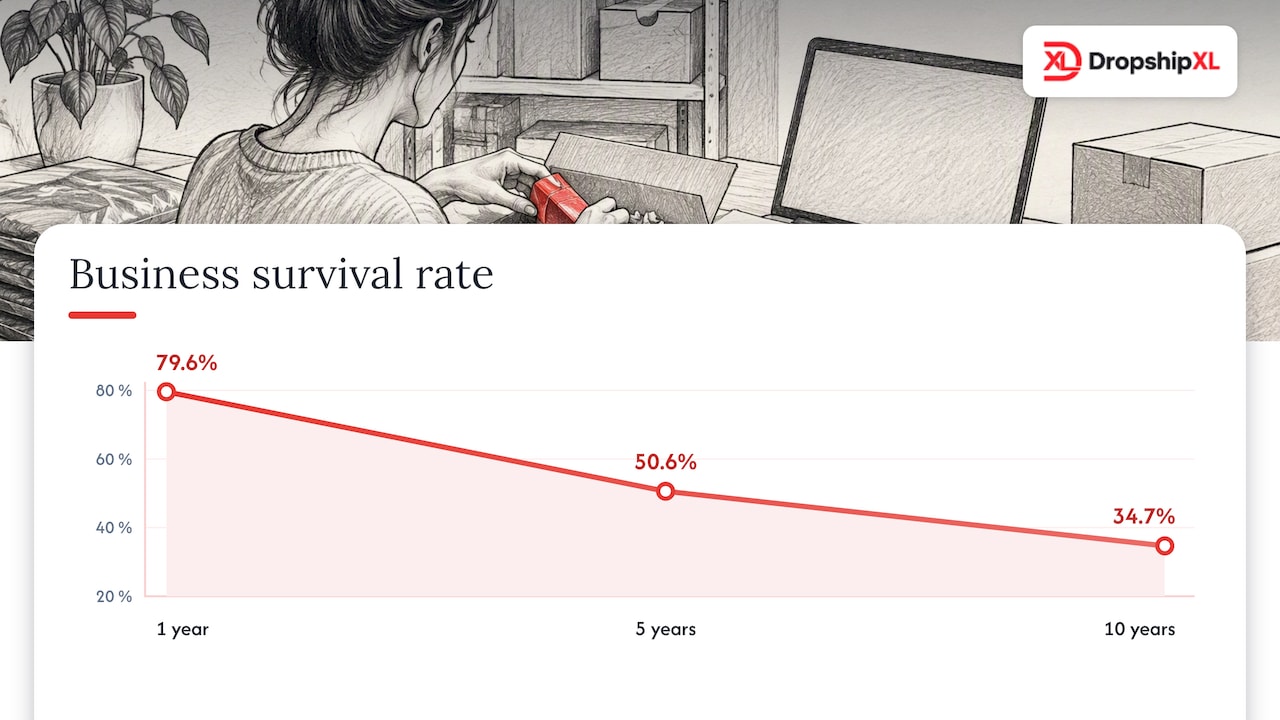
This covers all kinds of businesses, many with leases and employees, so it is not a dropshipping rate. But it gives you a useful sense of scale. Even in the general economy, surviving is the exception to be earned, not the default, and a first-year survival rate near 80% is a long way from “90% fail in year one.”
The early testing phase is where most people drop out
Ads Bench tracked 6,985 new stores that started advertising in July 2026. 57% stopped advertising before their first month was over. That is not proof that 57% of dropshippers fail, since some may have paused or relaunched. But it shows how much churn happens in the first few weeks, usually right when the first test fails.
Product-level data points the same way. A ZenoX measurement of 95,149 fashion products with real ad spend found that 71.7% generated zero sales within 30 days. Read that carefully: most individual products flop. The sellers who build real businesses are the ones who expect that and test enough, cheaply enough, to find the products that do not.
That is the first success principle in this article: failure of a product is normal; failure of a process is what ends a business.
Earnings claims are not evidence
Be skeptical of anyone who quotes a success rate to sell you something. In its 2024 complaint against Ecommerce Empire Builders, the Federal Trade Commission alleged that promises of $10,000 a month or millions from dropshipping were false or unsubstantiated and that the advertised results were far from typical. The same complaint describes programs priced from roughly $997 to $35,000.
The lesson is not that all training is bad. It is that testimonials and screenshots cannot tell you a success rate, and you should judge any program by its process, its transparency, and what it actually delivers.
Is dropshipping dead? Can you still make money in 2026?
No, but the easy version is gone. The old model of buying cheap overseas goods and shipping them duty-free to U.S. customers has been squeezed hard. U.S. Customs and Border Protection now states that merchandise valued at $800 or less must use formal or informal entry procedures, with all applicable duties and taxes paid. Analysts also point to rising tariffs and higher customer acquisition costs, and conclude the model remains viable for sellers who adapt, especially with U.S.-based logistics and a brand-focused approach.
In practice, here is what that means for a new store:
- Favor U.S.-based suppliers and warehouses. Faster shipping, fewer customs surprises, fewer refund requests.
- Sell something with a real margin. Thin-margin commodity goods get crushed when ad costs rise.
- Build a brand, not a catalog. A store people remember can earn repeat orders and cheaper traffic.
- Treat retention as part of the plan. Email, post-purchase offers, and a smooth checkout matter more as ads get pricier.
If you are setting up from scratch in this market, our 2026 startup guide for dropshipping in the US walks through the legal and operational basics.
Why dropshippers fail
Strip away the percentages and the same causes keep showing up. Here they are, with the fix for each.
1. Picking products on a hunch
If more than 70% of tested products make no sales in 30 days, guessing is expensive. Use data first: demand signals, competition, and supplier reliability. Our guide to product research tools for dropshipping covers how to narrow the field before you spend a dollar on traffic.
2. Skipping niche validation
A product can be fine and a niche can still be wrong: too saturated, too seasonal, or too price-driven. Work through the steps to validate a dropshipping niche in 2026 before you build.
3. Ad costs that outrun margins
This one is simple math. Say your product sells for $60 and the product plus shipping costs $36, so you keep $24 (40%) before ads and fees. Your break-even return on ad spend is $60 divided by $24, or 2.5. If your ads return less than $2.50 in sales for every $1 spent, you lose money on each order. Stripe notes that established stores can reach net margins of 15% to 25%, provided they hold a 3x to 4x markup over wholesale cost. Know your numbers before you launch, and run them through a dropshipping profit calculator to catch the hidden costs most beginners miss.
4. Unreliable suppliers
Late shipments and stockouts turn into refunds, chargebacks, and bad reviews. The FTC’s Mail, Internet, or Telephone Order Merchandise Rule requires sellers to have a reasonable basis to ship within the stated time, or within 30 days if none is stated, and to offer refunds or get consent for delays. You are responsible for the promise on your store, even when the supplier ships the box. Vet suppliers, order samples, and set delivery times you can actually meet.
5. A store that does not convert
Traffic is expensive, so a weak product page burns money. Fix the page before you scale spend; our product page optimization fixes are the first three we would test.
6. Quitting during the learning curve
New stores frequently take early losses while learning ad platforms, supplier logistics, and chargeback risk, as one 2026 guide notes. Quitting after two failed tests is the single most common way to guarantee a zero.
How long does it take to profit?
Expect months, not weeks. ZIK Analytics reports that early sales can come within a few months, but steady, dependable profit usually takes six to twelve months. Treat that as a rough guide rather than a promise. Your timeline depends on budget, niche, and how fast you learn from tests.
A realistic early path looks like this:
| Phase | Typical focus | What “progress” looks like |
|---|---|---|
| Months 1 to 2 | Niche validation, supplier approval, store setup | A store that is live, with policies and trusted suppliers |
| Months 2 to 4 | Small, controlled ad tests | First sales and clear data on cost per purchase |
| Months 4 to 8 | Cutting losers, doubling down on winners | Positive contribution margin on at least one product |
| Months 8 to 12 | Scaling and retention | Repeatable profit you can predict |
The table is our working framework, not a published benchmark.
Also be exact about “profit.” Revenue is not profit. Count what you keep after product and shipping costs, payment fees, apps, advertising, and a refund buffer. The number that matters is contribution margin per order after marketing.
Can you make $1,000 or $10,000 a month?
Yes, some sellers do, and no one can promise you will. We have found no reliable published median for beginner dropshipping income, so here is arithmetic instead of hype.
Suppose your net margin after all costs is 20%. To keep $10,000 a month, you need about $50,000 in monthly revenue. At a $60 average order, that is roughly 833 orders a month, or about 28 a day. At a 15% net margin, you need around $66,700 in revenue. For $1,000 a month at 20%, you need $5,000 in revenue, about 83 orders.
So $1,000 a month is a realistic first milestone for a well-run store. $10,000 a month is a business that needs steady traffic, strong conversion, and repeat customers. Our dropshipping scaling strategies list shows how stores move from the first level to the second.
What the stores that make it do differently
The pattern among sellers who last is consistent:
- They validate before they build. Demand and margin first, store second.
- They test small and often. Many cheap tests beat one big bet.
- They know their numbers. Break-even ROAS, contribution margin, refund rate.
- They choose reliable suppliers. Fast, U.S.-based when possible.
- They build a brand. That means repeat customers and pricing power.
- They get feedback early. A mentor shortens the expensive part of the learning curve.
Some eventually hold their own inventory under their own brand, which is a natural next step when a product proves itself. If that is where you are headed, this guide on building an Amazon private label brand is a good look at the stocked-product path. You can also browse examples of successful dropshipping stores in 2026 to see how real stores position themselves.
Our perspective on the success rate
We do not quote a success rate, because an honest one does not exist, and anyone who gives you a neat figure is guessing or selling. What we can tell you comes from doing the work. I have built and scaled my own ecommerce brand to six and seven figures using the same 7-step process we teach, and I have mentored more than 3,270 students through it over 16 years.
What I see over and over is that success has little to do with luck or a secret product. It comes down to a system: pick a niche you can validate, get approved with real suppliers, set up a store that converts, prove the product with small tests, then scale only what works. The students who struggle usually skipped a step, usually the validation or the numbers. The ones who stick with the process, track their margins, and ask for help early are the ones who get through the first six to twelve months.
So do not worry about the 90%. Worry about the next step in your process, and do it well, every day.
— Trent
Get a proven process instead of guessing
If you want structure, the DropshipXL Academy Membership V7.1 gives you our full 7-step curriculum for $997 per year, covering niche selection, supplier sourcing, store setup, marketing validation, and scaling.
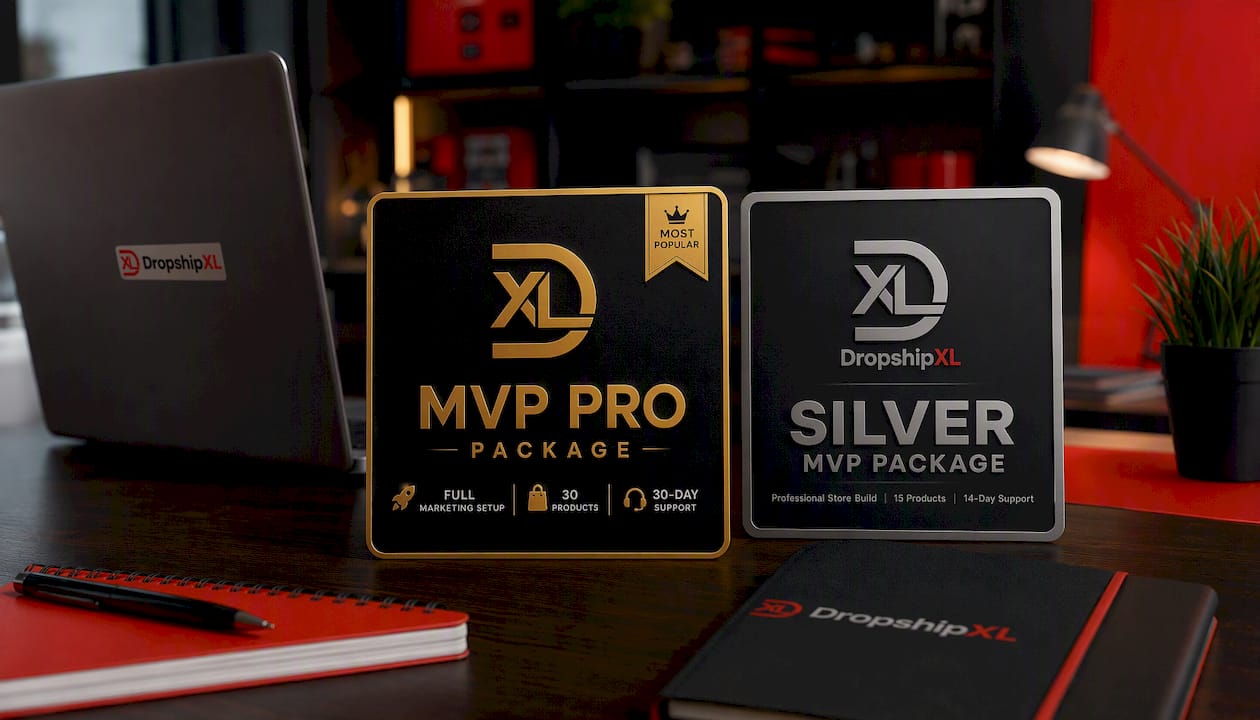
If you would rather have the store built for you, our done-for-you options are one-time payments: the Bronze MVP Package at $1,297, the Silver MVP Package at $1,997, and the MVP PRO Package at $2,897. For a single high-converting page, DFY Focus 1 is $497, or $697 with mentoring. Want personal guidance? Ask us about 1-on-1 dropship mentoring.
FAQ
What is the success rate of dropshipping?
There is no verified figure. Popular numbers like 90% failure have no documented primary source, and they rarely say who was counted or for how long. A better benchmark is broader: BLS data shows about half of U.S. business establishments still operating after five years.
Why do most dropshippers fail?
The common causes are weak product choices, ad spend that exceeds margins, unreliable suppliers, and quitting during the early testing phase. Data shows most individual products make no sales within 30 days, so sellers who do not test systematically run out of money or patience before they find a winner.
How long does it take to make a profit dropshipping?
First sales can come within a few months, but steady profit commonly takes six to twelve months. Your timeline depends on your budget, niche, and how quickly you learn from each test. Measure profit as contribution margin after marketing, not revenue.
Is dropshipping dead in 2026?
No, but the cheap, duty-free overseas model has been hit by tariffs and customs rules, and ad costs are higher. Sellers who use U.S.-based suppliers, protect their margins, and build a brand can still make money.
Can you make $10,000 a month dropshipping?
It is possible but not typical, and no one should promise it. At a 20% net margin you would need around $50,000 in monthly revenue, which takes strong conversion, steady traffic, and repeat buyers. Treat $1,000 a month as the first milestone and build from there.

Here are 4 other ways I can help you when you're ready: